
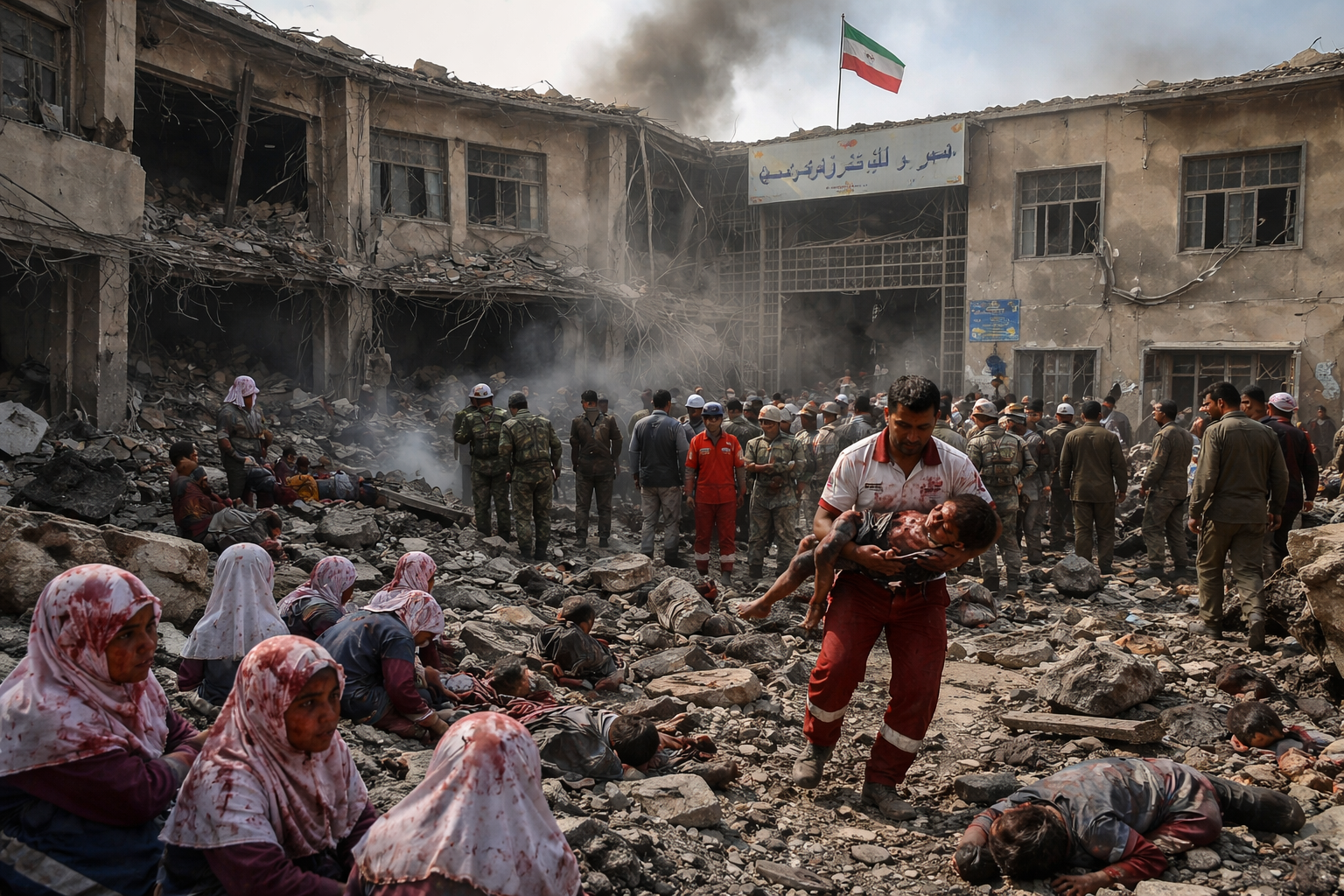
The report that Israel bombed an Iranian school, with 24 deaths reported including women, has rapidly become one of the most discussed developments in Middle East security news. Allegations of a strike on civilian infrastructure — particularly a school — carry immediate legal, moral, and geopolitical implications.
In conflicts marked by deep mistrust and indirect confrontation, even a single airstrike can shift regional calculations. When the reported target is a school and the casualty toll includes women, the incident moves beyond military analysis into the realm of humanitarian crisis and international law.
As with all breaking developments in high-tension regions, facts are still emerging. Early figures may change. Official confirmations may be delayed. Competing narratives are already shaping how the world understands what happened.
This report examines what is known, what remains unclear, and why the alleged incident matters far beyond its immediate location.
Breaking News: What Has Been Reported So Far
Initial regional sources claim that Israel conducted a strike on a location in Iran that was later identified as a school facility. According to early reports, 24 people were killed, and women were among the victims.
At this stage, several critical questions remain open:
- Was the building functioning as an active school at the time of the strike?
- Was it allegedly being used for military purposes?
- Was the school near a strategic target?
- Have independent observers verified the casualty count?
In conflict reporting, the first wave of information often comes from local authorities. These figures can be accurate — or later revised. Satellite imagery, third-party investigators, and international observers typically require time to access reliable evidence.
For now, the key confirmed element is the seriousness of the allegation: a strike on Iranian soil resulting in civilian deaths connected to a school building.
Israel and Iran: A Conflict Without Formal War
To understand the gravity of the headline “Israel bombed Iranian school,” it is necessary to view it within the broader Israel–Iran relationship.
Israel and Iran do not engage in open, declared warfare. Instead, their conflict operates in layers:
- Cyber operations
- Covert intelligence activities
- Proxy conflicts in third countries
- Limited airstrikes outside direct borders
Israel has repeatedly stated that it will prevent Iran from establishing military infrastructure that could threaten Israeli territory. Iran, in turn, has supported armed groups opposed to Israel.
Historically, Israeli-attributed airstrikes have focused on Iranian-linked targets in countries such as Syria. Direct strikes inside Iran, if confirmed, represent a different level of escalation.
That distinction matters. Actions inside sovereign territory carry heavier diplomatic and military consequences than indirect confrontations.
Civilian Infrastructure in Modern Conflict
Schools hold a unique position in armed conflict. They symbolize education, community life, and civilian stability. Under international humanitarian law, they are protected civilian objects.
However, international law also recognizes that if civilian infrastructure is used for military purposes, it may lose protected status. This is not a simple or automatic determination. It requires:
- Clear evidence of military use
- Assessment of proportionality
- Consideration of civilian harm
If a school building was being used for storage of weapons or military planning, it complicates legal analysis. But even in such cases, the attacking party must evaluate whether the expected military advantage outweighs potential civilian casualties.
When women are reported among the 24 dead, it strengthens the civilian harm narrative. The presence of women in casualty lists often signals that non-combatants were likely affected.
At this point, without independently verified intelligence, any firm legal conclusion would be premature.
The Human Toll Behind “24 Deaths”
Numbers in conflict reporting can become detached from reality. Twenty-four deaths may appear as a statistic on a screen. But in local communities, that number represents families shattered, children orphaned, and social networks permanently altered.
If the building was functioning as a school, the emotional impact intensifies. Even if classes were not in session, schools represent safety in the public imagination.
In regions already living under geopolitical tension, fear of sudden violence shapes daily life. Parents question whether public buildings are safe. Teachers worry about gathering students. Ordinary routines become uncertain.
Civilian harm is not limited to fatalities. Survivors may face:
- Long-term physical injuries
- Psychological trauma
- Displacement
- Economic instability
The ripple effect can last years beyond the strike itself.
Information Warfare and Competing Narratives
In modern conflicts, narratives move almost as quickly as missiles.
When headlines declare that Israel bombed an Iranian school, the framing shapes public perception before detailed facts emerge. Governments, advocacy groups, and international actors often present the same event in sharply different terms.
Iranian officials may describe the strike as deliberate aggression against civilians. Israeli officials, if involved, may argue that the target had military relevance.
Social media accelerates the spread of unverified claims. Photos and videos circulate instantly, sometimes without context. In past global conflicts, initial reports have later been corrected — either upward or downward in casualty numbers.
For readers and observers, caution is not indifference. It is a necessary discipline in an environment where information is strategic.
International Law and Accountability Mechanisms
If the allegations are substantiated, international law frameworks would come into focus.
The principles of distinction, proportionality, and precaution form the foundation of lawful conduct in armed conflict. Even in intense security situations, parties are obligated to minimize civilian harm.
Possible next steps in such incidents typically include:
- Calls for independent investigation
- Requests for satellite imagery analysis
- Statements from international human rights organizations
- Diplomatic consultations at the United Nations
However, accountability often depends on political realities. Access to the site, cooperation from authorities, and geopolitical alliances influence whether formal investigations proceed.
In many historical cases, disputes over interpretation persist for years.
Regional Implications and Escalation Risks
A confirmed Israeli strike inside Iran that caused civilian deaths would represent a significant escalation.
Iran’s response could take multiple forms:
- Direct military retaliation
- Cyber operations
- Proxy group activity in neighboring countries
- Diplomatic escalation
Israel’s strategic calculus often prioritizes preemptive action against perceived threats. However, civilian casualties shift the political landscape.
Neighboring countries would likely reassess security posture. Energy markets might react to instability. Insurance costs for regional shipping routes could rise.
Escalation does not always come immediately. Sometimes it unfolds gradually, through a cycle of action and counteraction.
Diplomatic Backchannels and De-escalation Efforts
Public rhetoric in moments like this can be intense. Leaders may issue strong statements condemning or defending actions.
Behind the scenes, however, diplomatic channels often activate quietly. Third-party mediators, intelligence officials, and regional powers may attempt to prevent broader conflict.
History shows that even adversaries with no formal diplomatic ties sometimes communicate indirectly during crises. The goal is rarely reconciliation. It is usually containment.
Whether this reported strike becomes a turning point or a contained incident depends heavily on these unseen conversations.
Media Responsibility in Reporting Civilian Harm
News organizations face pressure to report quickly. Speed competes with verification.
Responsible reporting distinguishes between:
- Confirmed facts
- Government statements
- Unverified claims
- Analysis and speculation
When dealing with reports that Israel bombed an Iranian school, precision is critical. Words like “alleged,” “reported,” and “according to local authorities” are not evasions. They reflect the reality of evolving information.
Sensational framing may attract attention, but careful language builds trust over time.
Broader Historical Context
Cross-border strikes in the Middle East are not new. What changes is the location, scale, and political moment.
Direct strikes inside Iran are rare compared to operations in third-party territories. If confirmed, this would represent a shift in operational boundaries.
The broader strategic contest between Israel and Iran includes concerns about military expansion, missile capabilities, and regional influence. Each incident fits into that larger mosaic.
But individual strikes, especially those involving civilian deaths, can reshape that mosaic quickly.
Public Reaction and International Response
Global reaction to allegations of a strike on a school is typically swift. Governments may issue:
- Condemnations
- Calls for restraint
- Demands for investigation
- Appeals for de-escalation
Public demonstrations sometimes follow major civilian casualty events. Social media campaigns amplify narratives. Diaspora communities often mobilize to voice concern or outrage.
International response also depends on verification. If evidence clearly confirms civilian targeting without military justification, diplomatic pressure intensifies.
If circumstances appear more complex, reactions may be more measured.
The Role of Independent Verification
In high-stakes incidents, independent verification plays a crucial role.
Tools commonly used by investigators include:
- Satellite imagery comparison
- Analysis of blast patterns
- Geolocation of videos
- Interviews with survivors
Open-source intelligence communities have become increasingly influential in verifying or challenging official claims.
However, even with modern tools, certainty can take time.
Long-Term Implications for Regional Stability
Even if the immediate crisis is contained, incidents like this leave residue.
Trust erodes further. Military postures harden. Civil defense planning increases. Public opinion shifts.
In regions where tensions are already high, a single episode can alter strategic calculations for years.
Civilian harm complicates future negotiations. It shapes how populations perceive adversaries. It deepens narratives of victimhood and grievance.
Why Careful Analysis Matters
The claim that Israel bombed an Iranian school with 24 deaths reported including women is serious. It deserves attention grounded in fact, law, and context.
Outrage may be understandable. But durable understanding requires patience.
In conflict reporting, clarity often emerges slowly. Accountability processes move deliberately. Diplomatic efforts unfold quietly.
The human cost, however, is immediate.
Frequently Asked Questions
Is there confirmed evidence that a school was deliberately targeted?
As of now, publicly available information does not conclusively establish intent. Investigations and independent verification would be required to determine targeting decisions.
Were the 24 deaths independently verified?
Initial casualty figures often come from local authorities. Independent confirmation typically takes additional time and access to the site.
Why would Israel strike inside Iran?
Israel has previously acted against what it describes as security threats linked to Iranian military activities. Whether this specific incident fits that pattern remains unclear.
Does this mean full-scale war is imminent?
Not necessarily. Escalation depends on political decisions by both sides. Past crises have sometimes been contained through indirect diplomacy.
What protections do schools have under international law?
Schools are considered civilian infrastructure and are protected unless used for military purposes. Even then, strict proportionality rules apply.
The reported incident of Israel bombing an Iranian school, with 24 deaths including women, underscores the fragility of regional stability. Whether the event proves to be a deliberate targeting of civilian infrastructure or a disputed military action, its consequences extend beyond the immediate site.
