
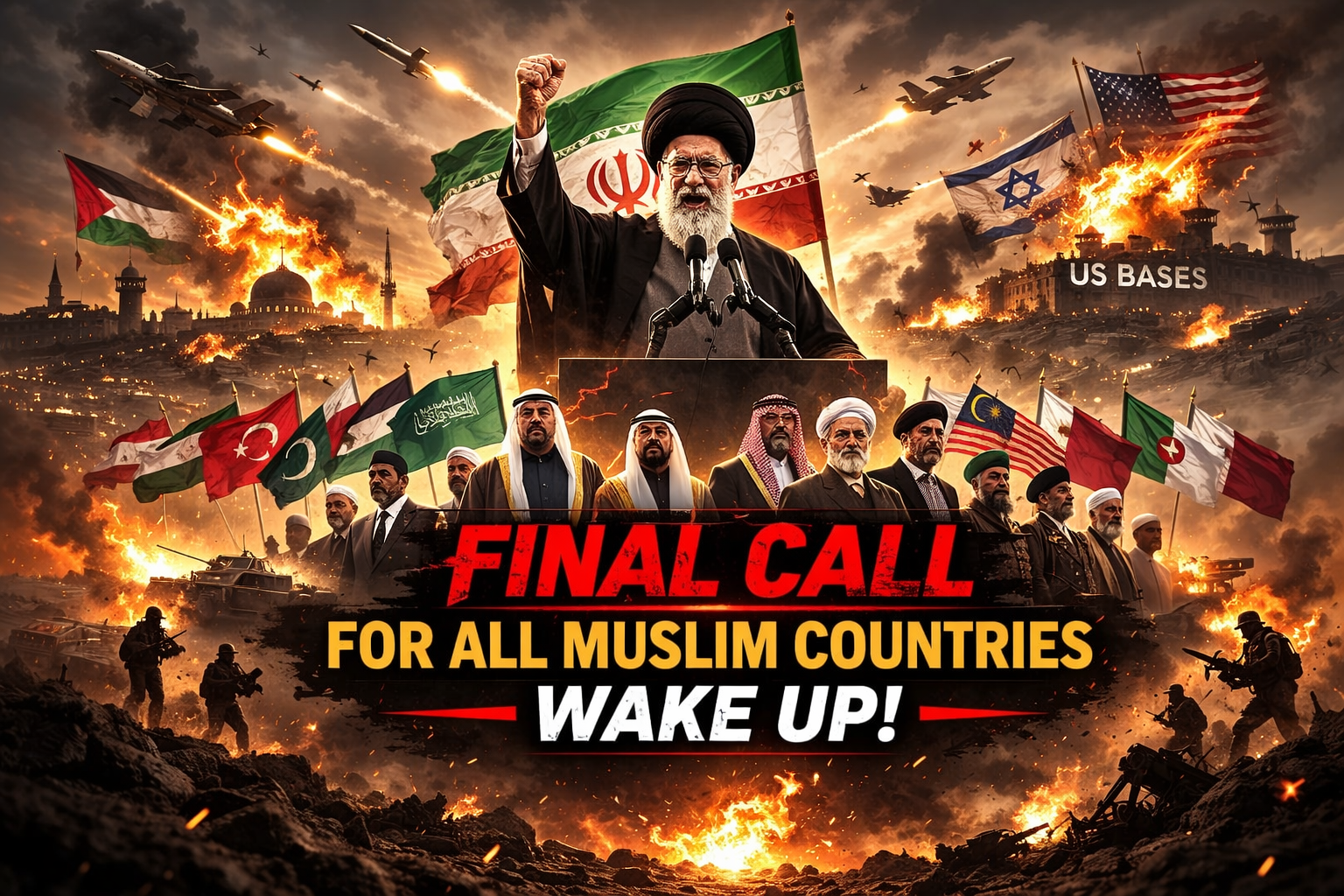
The phrase “final call for all Muslim countries, wake up!” began circulating widely after Iranian forces reportedly carried out strikes targeting Israeli and US-linked military sites. Within hours, state media clips, translated statements, and social media posts amplified the message far beyond the region.
The words themselves were not long. But they were loaded — politically, religiously, and strategically. In moments of military escalation, language becomes more than rhetoric. It becomes a tool of positioning, signaling, and psychological influence.
To understand what this message means — and what it does not — it helps to step back from the noise and examine the broader geopolitical context.
The Military Escalation: What Happened?
Tensions between Iran, Israel, and the United States have simmered for years. Proxy conflicts, covert operations, cyber warfare, and targeted strikes have defined the shadow war long before any public announcement.
When Iranian forces launched strikes — whether directly or through allied groups — the action marked more than retaliation. It signaled a willingness to escalate beyond indirect confrontation.
Military analysts often describe such strikes as “calibrated.” They are designed to send a message without triggering full-scale war. But messaging matters as much as missiles.
The “wake up” call was not just about a battlefield moment. It was about shaping regional perception.
Why Use Religious Framing in a Geopolitical Conflict?
The phrase “final call for all Muslim countries” shifts the narrative from state-to-state conflict to civilizational solidarity.
That shift is deliberate.
Political Strategy Behind Religious Language
Governments sometimes frame political disputes in religious or ideological terms to:
- Strengthen domestic support
- Rally sympathetic populations abroad
- Pressure neighboring governments
- Reframe military action as moral duty
By invoking “all Muslim countries,” the message attempts to expand the issue beyond Iran and Israel. It suggests that neutrality equals silence — and silence equals complicity.
But reality is far more complex.
The Muslim world is not politically unified. Countries such as Saudi Arabia, Turkey, Pakistan, and United Arab Emirates each have distinct foreign policy priorities, economic ties, and security concerns.
Religious identity does not automatically translate into military alignment.
Regional Reactions: Silence, Caution, and Calculated Statements
After such strikes, most governments avoid immediate emotional responses. Instead, they issue carefully worded statements calling for restraint.
Why?
Because escalation carries consequences.
- Energy markets react instantly
- Trade routes face disruption
- Diplomatic relations shift
- Domestic stability becomes fragile
For Gulf nations, economic modernization and regional investment often outweigh ideological alignment. For countries like Turkey, balancing relations between NATO commitments and regional influence requires delicate maneuvering.
So while the “wake up” message may resonate emotionally with some audiences, governments typically operate within pragmatic constraints.
The US and Israel’s Strategic Position
From Israel’s perspective, Iranian military action reinforces long-standing security concerns. Israel has repeatedly stated that it views Iranian military expansion in the region as an existential threat.
The United States, meanwhile, maintains military assets and alliances across the Middle East. Any strike on US bases immediately raises the stakes.
But even here, responses are rarely impulsive. Military retaliation is weighed against diplomatic fallout. Cyber responses, targeted sanctions, or back-channel negotiations are often preferred before broad escalation.
Escalation is easier to trigger than to control.
Media Amplification and Narrative Warfare
In modern conflicts, information spreads faster than missiles.
Short video clips, translated speeches, and dramatic headlines circulate globally within minutes. The phrase “final call for all Muslim countries, wake up!” gained traction not only because of its content but because it was emotionally charged and easily shareable.
This is narrative warfare.
Each side seeks to:
- Define who is aggressor and who is defender
- Frame actions as justified
- Shape international opinion
- Influence domestic morale
And in that environment, language is sharpened deliberately.
The Reality of Muslim World Politics
It is tempting to imagine a unified bloc of Muslim-majority nations responding collectively. History suggests otherwise.
During previous regional crises — from wars in Iraq to conflicts in Syria — Muslim countries took varied and sometimes opposing positions.
Economic ties complicate matters further. Many Gulf states maintain quiet security coordination with the US. Some have normalized relations with Israel in recent years. Others maintain strategic distance from both sides.
Unity based purely on religious identity rarely overrides national interest.
Could This Lead to a Wider War?
This is the question most ordinary citizens ask.
The answer depends on several variables:
- Was the strike symbolic or strategically damaging?
- Does retaliation escalate proportionally or exponentially?
- Are diplomatic back channels active?
- Are regional powers willing to mediate?
History shows that regional flare-ups often stop short of total war because the cost is too high for all parties.
However, miscalculation remains a constant risk.
The Economic Dimension: Oil, Trade, and Stability
Whenever Iran, Israel, and the United States are involved in open confrontation, oil markets react.
The Strait of Hormuz — a narrow shipping corridor near Iran — handles a significant portion of global oil shipments. Any threat to maritime traffic there creates immediate economic anxiety.
Even countries far from the conflict feel the ripple effects through:
- Fuel prices
- Inflation
- Investment instability
- Currency fluctuations
So while the rhetoric may be ideological, the consequences are deeply economic.
Public Sentiment vs Government Policy
There is often a gap between street-level emotion and state-level decision-making.
Protests may erupt in various cities. Social media campaigns may trend. Religious leaders may issue strong statements.
But governments calculate:
- Military capability
- Economic vulnerability
- Alliance obligations
- Domestic security
The “wake up” call may stir public sentiment, but translating that into coordinated state action is far more complicated.
Strategic Signaling: What Iran Might Be Communicating
Beyond the religious appeal, the message likely serves several strategic purposes:
- Demonstrating deterrence capability
- Warning regional rivals
- Reasserting influence after prior setbacks
- Testing international response
In geopolitical chess, signaling is essential. A strike combined with a broad message creates both military and psychological impact.
But signaling also invites counter-signaling.
The Risk of Polarization
When conflicts are framed in religious or civilizational terms, polarization deepens.
Diplomacy becomes harder. Compromise appears like betrayal. Public discourse grows more rigid.
Long-term stability in the Middle East has historically depended not on emotional unity, but on negotiated balance.
That balance is fragile.
What Happens Next?
Several possible scenarios exist:
- Limited retaliatory exchanges
- Cyber or covert escalation
- Sanctions and diplomatic pressure
- Temporary de-escalation through mediation
Countries such as Oman or Qatar have previously played quiet mediating roles in regional disputes. Whether such channels are active again is rarely public knowledge.
In moments like this, silence from leaders can sometimes signal negotiation rather than indifference.
FAQ: Final Call for All Muslim Countries, Wake Up
Why did Iranian forces use religious language in their message?
Religious language can broaden a political message beyond national borders. It appeals to shared identity, even when governments may not align politically.
Are Muslim countries likely to unite militarily because of this call?
Historically, Muslim-majority nations have acted based on national interests rather than religious solidarity alone. Collective military action is unlikely without direct strategic benefit.
Could this escalate into a regional war?
It is possible but not inevitable. Escalation depends on proportional responses and the effectiveness of diplomatic back channels.
How does this affect global oil prices?
Any tension involving Iran and US-linked military sites can trigger market uncertainty, especially due to the strategic importance of shipping routes in the Gulf.
Is this conflict purely religious?
No. While religious language may be used, the underlying conflict involves geopolitics, security strategy, alliances, and regional power competition.
A Moment of High Tension, Not a Simple Narrative
The phrase “final call for all Muslim countries, wake up!” captures attention because it sounds urgent and sweeping. But geopolitics rarely operates in absolutes.
Behind dramatic messaging lie calculations, constraints, and competing priorities.
Military strikes can shift momentum. Words can shift perception. Yet lasting outcomes depend less on emotional appeals and more on strategic decisions made quietly behind closed doors.

One thought on “Final Call for All Muslim Countries, Wake Up!” — Message by Iranian Forces After Striking Israel & US Bases”