
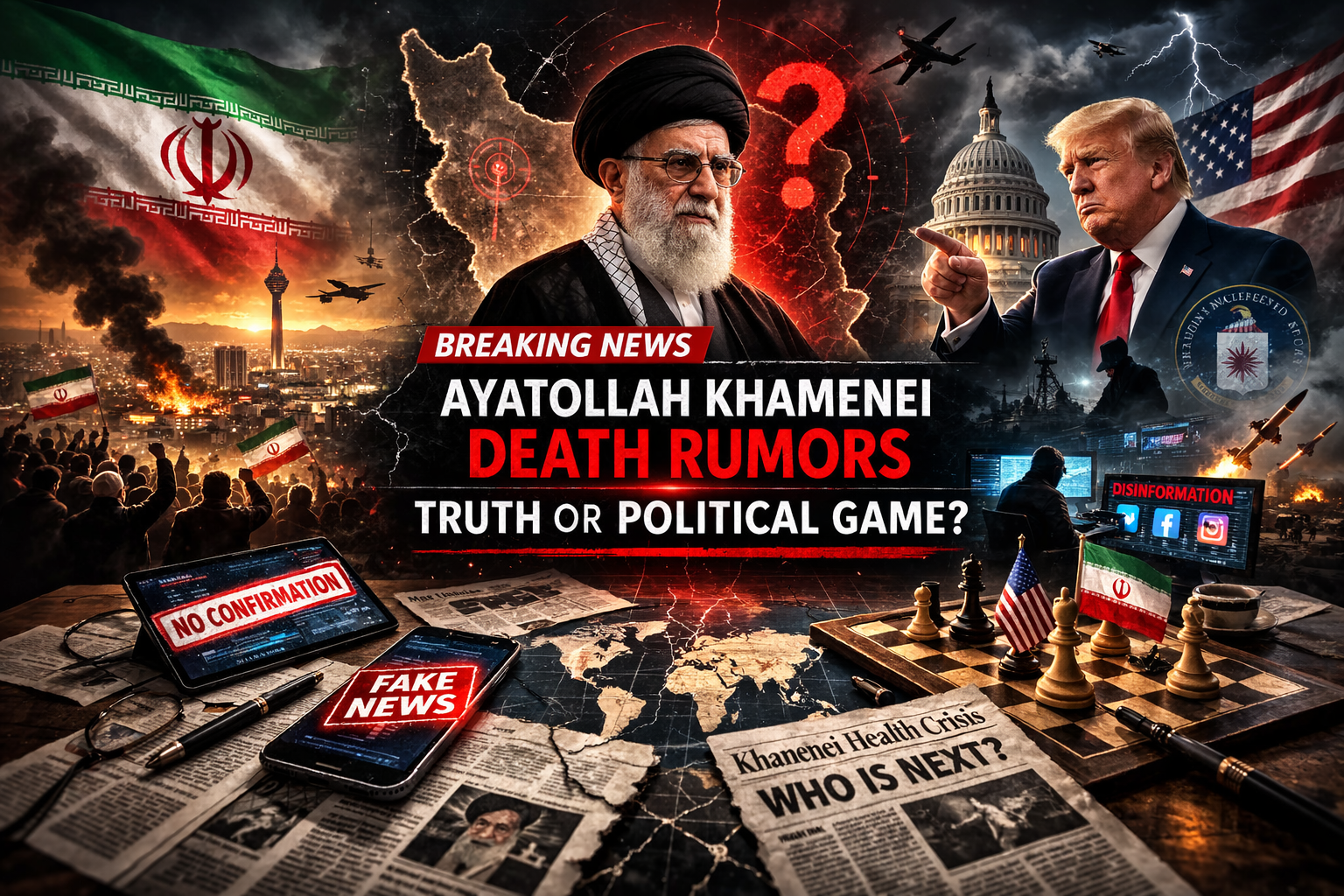
Search engines regularly show spikes for phrases like “Ayatollah Khamenei death true are Trump’s dirty politics.” The wording alone reflects confusion, suspicion, and political tension. It blends a health rumor with a partisan accusation, suggesting that if the claim isn’t true, it must be politically engineered.
At the center of this speculation is Ali Khamenei, Iran’s Supreme Leader since 1989. On the other side is Donald Trump, whose foreign policy toward Iran marked one of the most confrontational periods in recent U.S.–Iran relations.
But are these rumors grounded in fact? Or are they a product of political polarization and the modern information ecosystem? A careful look at context, incentives, and evidence tells a more measured story.
Who Is Ayatollah Khamenei and Why His Health Matters Globally
Ali Khamenei is not merely a symbolic head of state. In Iran’s political structure, the Supreme Leader holds ultimate authority over the armed forces, judiciary, state broadcasting, and major strategic decisions.
He succeeded Ruhollah Khomeini following the 1979 Islamic Revolution. Since then, Khamenei has shaped Iran’s domestic governance and foreign policy direction for more than three decades.
Unlike many Western political systems where power is divided across institutions, Iran’s Supreme Leader maintains significant centralized authority. That makes any discussion about his health far more than a personal matter.
If his status changes, it could influence:
- Regional security dynamics
- Oil market stability
- Nuclear negotiations
- Internal political alignments
In geopolitics, leadership continuity often equals stability. Leadership uncertainty, by contrast, can trigger speculation and market reactions.
Is the Ayatollah Khamenei Death Claim True?
As of the most recent verified reporting from credible international media and official Iranian sources, there has been no confirmed announcement of Ali Khamenei’s death.
Rumors about his health and alleged death have surfaced multiple times over the past decade. Each instance followed a similar pattern:
- An unverified post appears on social media.
- Anonymous sources are cited.
- Screenshots of “breaking news” circulate.
- Partisan commentators amplify the claim.
Within hours, the rumor spreads widely. Days later, it typically fades after official appearances or denials.
Iran’s state media continues to publish footage and statements attributed to Khamenei. While transparency about his medical condition remains limited, there is no verified evidence supporting claims of his death.
It’s important to distinguish between limited public visibility and confirmed death. In tightly managed political systems, health updates are often controlled, which can fuel suspicion even when no event has occurred.
Why Do These Rumors Keep Returning?
Three main factors explain the recurring nature of the Ayatollah Khamenei death rumor.
1. Age and Health History
Khamenei is in his eighties. In 2014, Iranian officials confirmed he underwent surgery related to prostate cancer. That disclosure made future health speculation almost inevitable.
In politics, age alone often triggers online rumors. Similar speculation has surrounded leaders in various countries when public appearances become less frequent.
2. Information Gaps
Iran does not provide detailed medical updates about its Supreme Leader. Limited transparency creates an information vacuum. And in today’s digital environment, vacuums rarely remain empty.
When official information is scarce, alternative narratives fill the space.
3. Geopolitical Tension
Rumors often spike during periods of heightened U.S.–Iran tension. Political friction increases audience appetite for dramatic developments.
This is where the “Trump’s dirty politics” angle enters the discussion.
The Trump–Iran Relationship: Context Behind the Speculation
During his presidency, Donald Trump significantly reshaped U.S.–Iran relations.
In 2018, the United States withdrew from the Joint Comprehensive Plan of Action (JCPOA), the multilateral agreement aimed at limiting Iran’s nuclear program in exchange for sanctions relief.
Following the withdrawal, the Trump administration imposed a “maximum pressure” sanctions campaign. Economic strain in Iran intensified.
In January 2020, the U.S. authorized a drone strike that killed Iranian General Qasem Soleimani. That action brought the two countries close to direct military confrontation.
Against that backdrop, it’s understandable why some observers suspect political motives when destabilizing rumors emerge.
However, suspicion alone does not equal evidence.
Is There Evidence Linking Trump to Khamenei Death Rumors?
Publicly available information does not show verified proof that Donald Trump or his political circle directly orchestrated death rumors about Khamenei.
Disinformation campaigns do exist globally. Governments and political actors sometimes engage in information warfare. But attributing a specific rumor to a specific political figure requires credible investigative evidence.
In the absence of that evidence, the claim remains speculative.
It’s also important to consider another possibility: not every rumor is strategically engineered. Many spread organically due to social media algorithms that reward emotionally charged content.
A headline suggesting the death of a powerful leader will attract attention regardless of who first posted it.
How Modern Political Rumors Gain Traction
Today’s information environment is shaped by speed and engagement.
When a claim appears online about the death of a major political leader, several mechanisms accelerate its spread:
- High engagement through shares and comments
- Influencers reposting without verification
- Foreign-language translations amplifying reach
- Click-driven websites publishing unverified updates
The structure of digital platforms favors dramatic claims over cautious reporting.
Corrections often travel slower than original rumors. By the time clarification arrives, millions may have already seen the initial claim.
This dynamic explains much of the recurring speculation surrounding Ayatollah Khamenei’s death without requiring a coordinated political conspiracy.
Why Leadership Succession in Iran Is a Sensitive Topic
Another reason the Ayatollah Khamenei death rumor generates attention is succession uncertainty.
Iran’s Supreme Leader is selected by the Assembly of Experts, a clerical body. While potential successors are occasionally discussed by analysts, official succession planning remains opaque.
A leadership transition would influence:
- Iran’s nuclear policy
- Relations with Gulf neighbors
- Regional proxy dynamics
- Domestic reform debates
Financial markets react to such uncertainty. So do regional governments.
That sensitivity makes rumors impactful even when untrue.
Political Polarization and Narrative Framing
The phrase “Trump’s dirty politics” reflects a broader pattern in modern discourse: framing complex geopolitical events through partisan narratives.
For critics of Trump, any destabilizing development involving Iran may be interpreted as fallout from his policies. For supporters, accusations of manipulation may appear politically motivated.
Polarization encourages people to interpret ambiguous events through existing beliefs.
But geopolitical realities rarely fit neatly into partisan categories.
Leadership rumors in authoritarian or semi-authoritarian systems occur across political cycles, not just under one administration.
The Role of Information Transparency
Transparency reduces speculation. Limited transparency increases it.
Iran’s controlled media environment contributes to recurring uncertainty. When leaders appear less frequently or release limited health information, speculation becomes predictable.
At the same time, Western media outlets sometimes rely on anonymous intelligence sources, which can also create confusion.
In a globalized information system, gaps on one side are quickly filled by commentary on the other.
The result is a cycle of rumor, reaction, and correction.
Evaluating Political Health Claims Responsibly
When encountering claims about a political leader’s death, a few practical steps help maintain perspective:
- Check for confirmation from multiple reputable international outlets.
- Look for official government statements.
- Avoid relying solely on social media screenshots.
- Consider timing — rumors often spike during diplomatic crises.
If a claim appears only on partisan blogs or anonymous accounts, skepticism is warranted.
In geopolitics, verified announcements carry weight. Viral posts do not.
The Bigger Picture: Rumors as a Symptom, Not a Strategy
The recurring Ayatollah Khamenei death rumor illustrates a broader challenge: declining trust in institutions and fragmented information ecosystems.
Political tensions amplify suspicion. Social media accelerates speculation. Limited transparency deepens uncertainty.
While strategic disinformation campaigns exist, not every rumor stems from a deliberate plan. Sometimes, structural incentives — attention, engagement, speed — are enough to explain why a claim spreads.
Blaming a single political figure without evidence simplifies a far more complex information landscape.
Frequently Asked Questions
Is Ayatollah Khamenei confirmed dead?
No verified reports from credible international media or official Iranian sources confirm his death. As of the latest reliable information, the claim remains unsubstantiated.
Why do people link these rumors to Donald Trump?
Trump’s confrontational policies toward Iran, including withdrawal from the nuclear deal and heightened sanctions, created political tension. Some interpret destabilizing rumors through that lens, though evidence directly connecting him to such claims is lacking.
How often have death rumors about Khamenei appeared?
They have surfaced multiple times over the past decade, typically during periods of political or regional tension.
Would his death significantly impact global politics?
Yes. As Iran’s Supreme Leader, any confirmed leadership transition would affect regional stability, nuclear diplomacy, and potentially global energy markets.
How can readers avoid being misled by political rumors?
Rely on multiple credible news organizations, wait for official confirmations, and approach emotionally charged headlines with caution.
Speculation thrives where transparency is limited and political tensions run high. In the case of Ayatollah Khamenei’s alleged death, verified evidence matters more than viral narratives. Until confirmed by credible sources, such claims remain rumors — not facts.
