
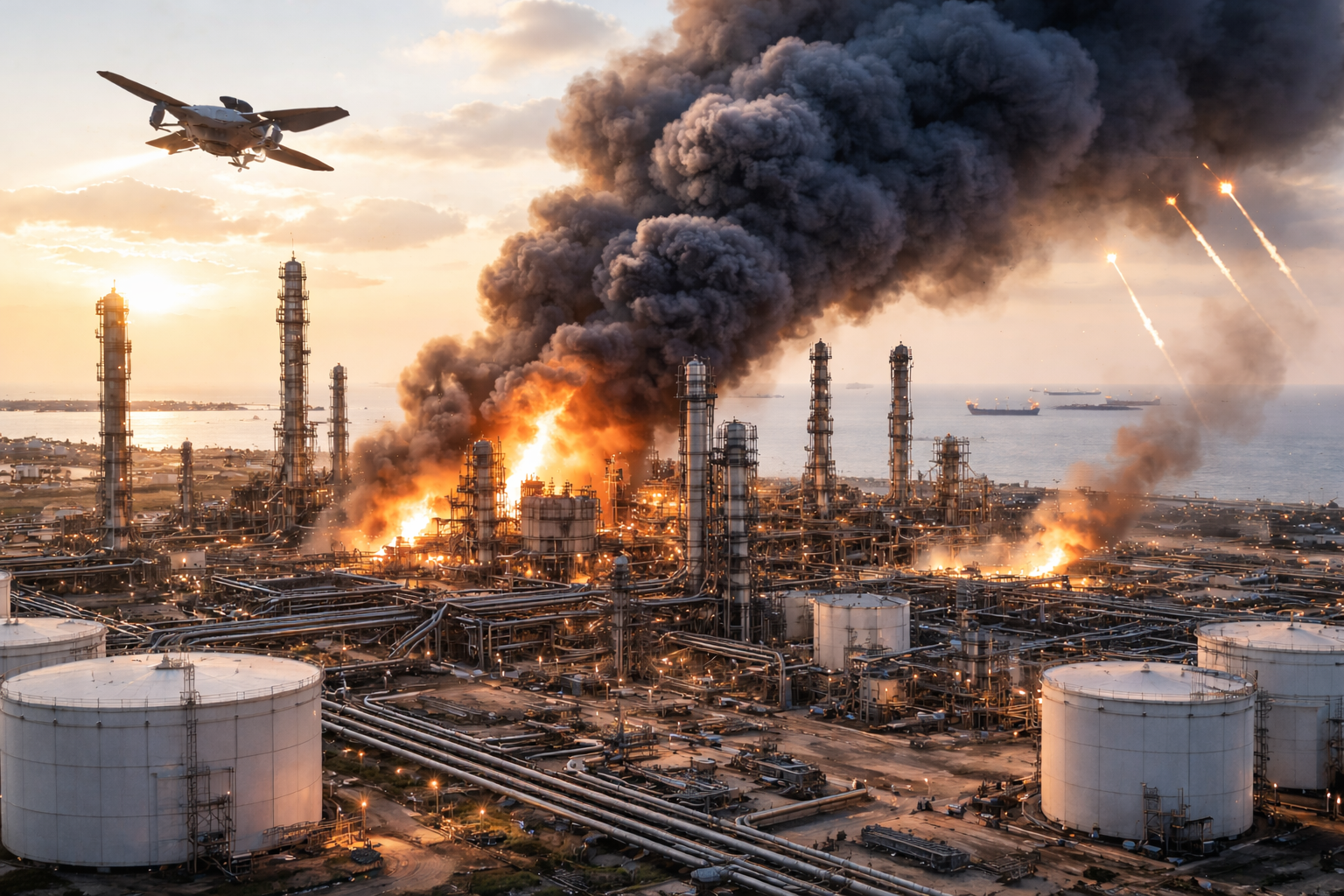
Saudi Arabia has shut down its massive Ras Tanura oil refinery following a drone strike attributed to Iran, a move that immediately raised concerns across global energy markets and diplomatic circles. The decision to halt operations at Ras Tanura, the kingdom’s largest refinery and one of the most important energy facilities in the world, underscores how quickly regional tensions can translate into real economic and strategic consequences.
The shutdown comes at a time when the Middle East is already navigating heightened military activity and fragile security conditions. While Saudi authorities have described the closure as precautionary, the implications extend well beyond the refinery’s perimeter, touching oil prices, regional stability, and the broader balance of power in the Gulf.
Why the Ras Tanura Oil Refinery Matters
The Ras Tanura oil refinery is not just another industrial site. Located on Saudi Arabia’s eastern coast, it forms part of a vast energy complex that includes storage facilities, pipelines, and one of the world’s busiest oil export terminals. On a normal day, Ras Tanura processes hundreds of thousands of barrels of crude oil into refined products that supply both domestic demand and international markets.
Because of its size and integration with export infrastructure, Ras Tanura plays a quiet but central role in keeping global energy flows steady. Disruptions here tend to resonate far beyond Saudi borders, especially for import-dependent economies in Asia and parts of Europe.
Saudi Arabia’s reputation as a reliable energy supplier has long rested on the resilience of facilities like Ras Tanura. Any interruption, even a temporary one, is therefore closely watched by governments, traders, and policymakers alike.
What Happened During the Drone Strike
According to Saudi officials, the refinery was targeted during a wave of drone activity linked to escalating tensions with Iran. Saudi air defense systems intercepted several drones approaching the eastern region, including the area around Ras Tanura. Debris from the interception reportedly caused a localized fire within the refinery complex.
The fire was contained, and there were no immediate reports of casualties. Still, the presence of any fire at a high-capacity refining facility is treated seriously. Within hours, operators initiated a controlled shutdown of the refinery to ensure the safety of personnel and to prevent potential damage to critical processing units.
The Saudi government emphasized that the shutdown was a precautionary measure rather than a response to catastrophic damage. Even so, the fact that a facility of this scale was taken offline highlights the sensitivity of energy infrastructure in periods of military tension.
A Precautionary Shutdown, Not a Collapse
It is important to distinguish between a shutdown and a loss of capacity. In this case, Saudi Arabia has not indicated that Ras Tanura has been permanently damaged. Modern refineries are designed with safety systems that allow for rapid shutdowns when risks emerge, whether from mechanical issues or external threats.
By halting operations early, operators can inspect equipment, assess structural integrity, and verify that no hidden damage occurred. This approach reduces the risk of secondary incidents, which could be far more disruptive than the initial strike.
Still, even a temporary shutdown at Ras Tanura carries weight. The refinery’s sheer scale means that any pause, however brief, can affect supply chains and market sentiment.
Immediate Impact on Oil Markets
News of the Ras Tanura shutdown quickly rippled through global oil markets. Prices reacted sharply, reflecting not only the loss of refining capacity but also fears of broader instability in the Gulf region.
Energy markets tend to price in risk as much as reality. Traders and analysts are acutely aware that the Persian Gulf hosts a dense concentration of oil infrastructure, much of it within range of drones or missiles. When one major facility is targeted, concerns naturally arise about others.
In this case, the market response was driven by uncertainty. How long would Ras Tanura remain offline? Could additional facilities be targeted? Would shipping routes be affected? Even without clear answers, the mere possibility of escalation was enough to move prices.
The Broader Geopolitical Context
The drone strike on Ras Tanura did not occur in isolation. It unfolded against the backdrop of intensifying regional tensions involving Iran, Israel, the United States, and several Gulf states. In recent weeks, the exchange of military actions and threats has increased, raising the risk of miscalculation.
For Saudi Arabia, the incident highlights a persistent challenge. The kingdom has invested heavily in air defenses and infrastructure protection, yet the evolving nature of drone warfare makes absolute security difficult. Relatively low-cost drones can pose outsized risks when they target high-value installations.
Iran, for its part, has repeatedly denied direct involvement in some past attacks while signaling its ability to influence events across the region. The ambiguity surrounding attribution often complicates diplomatic responses and heightens uncertainty.
What the Shutdown Means for Saudi Arabia
From a domestic perspective, Saudi Arabia is better positioned than most producers to absorb a temporary refinery shutdown. The country operates multiple refineries and maintains strategic reserves that can help smooth short-term disruptions.
Saudi Aramco, the state-owned energy giant, has long emphasized redundancy and flexibility in its operations. Crude oil exports can often be rerouted, and refined product supplies can be adjusted through other facilities.
That said, the symbolic impact of the Ras Tanura shutdown should not be underestimated. It underscores the reality that even the most well-defended infrastructure is not immune to regional instability. Over time, this may influence how Saudi Arabia allocates resources toward security, diversification, and risk management.
Global Energy Implications
The global energy system is tightly interconnected. When a facility like Ras Tanura goes offline, even briefly, the effects can be felt across multiple layers of the market.
Refined products from Saudi Arabia support transportation, industry, and power generation in many countries. Any sustained reduction in output could tighten supplies, particularly in regions that rely heavily on Middle Eastern exports.
At the same time, the world is not facing an immediate supply crisis. Strategic petroleum reserves, alternative suppliers, and existing inventories provide a buffer. The real risk lies in escalation. If attacks were to spread to multiple facilities or disrupt shipping lanes, the situation would look very different.
Security Risks to Energy Infrastructure
The Ras Tanura incident fits into a broader pattern seen over the past decade: energy infrastructure has become a preferred target in regional conflicts. Refineries, pipelines, and export terminals offer strategic leverage because of their economic importance.
Drones, in particular, have changed the calculus. They are harder to detect than traditional aircraft and can be launched with limited resources. Even when intercepted, falling debris can still cause damage, as seen in this case.
For energy-producing nations, this raises difficult questions. How much investment is enough to protect infrastructure? At what point do security costs outweigh the benefits of centralized, large-scale facilities?
What Happens Next
Several factors will shape the next phase of this situation. First is the technical assessment at Ras Tanura. Engineers will need to confirm that all systems are safe before operations resume. This process can take days or longer, depending on what inspections uncover.
Second is the regional security environment. If tensions ease, the shutdown may remain a short-lived event. If they worsen, Saudi Arabia and other producers may adopt a more cautious operational stance.
Finally, markets will continue to react to signals rather than certainties. Statements from governments, military developments, and even rumors can influence prices and sentiment.
Frequently Asked Questions
Why was the Ras Tanura oil refinery shut down?
The refinery was shut down as a precaution after debris from intercepted drones caused a limited fire. Operators halted operations to ensure safety and assess potential damage.
Is the shutdown permanent?
There is no indication that the closure is permanent. Authorities have described it as a temporary measure pending inspections and security assessments.
Did the attack significantly damage the refinery?
So far, reports point to limited damage rather than a major structural impact, but full inspections are required before restarting operations.
Will this affect global oil supply long term?
A short-term shutdown is unlikely to cause lasting supply issues. Prolonged disruptions or further attacks would pose a greater risk.
Why did oil prices react so strongly?
Markets responded to uncertainty and geopolitical risk, not just the loss of capacity. The possibility of escalation tends to drive sharp price movements.
Could similar attacks happen again?
While defenses are in place, the evolving use of drones means energy infrastructure across the region remains exposed to potential threats.
