
A Quiet Shift in How Messages Reach People
In recent years, the term Dualmedia Strategy has started appearing more frequently in conversations about communication, marketing, and digital engagement. At its core, it describes a structured approach where two complementary media channels work together to deliver the same message in different formats or environments.
Think of it like a well-designed multiplayer system. One channel might be the fast, real-time platform where people discover information quickly. The other provides depth, context, and credibility. When the two operate in sync, the communication experience becomes smoother, clearer, and more effective.
For organizations, publishers, and digital platforms, the rise of the Dualmedia Strategy reflects a growing reality: audiences no longer consume information in a single place. Messages travel across social feeds, websites, streaming platforms, messaging apps, and community forums. The strategy acknowledges that fragmented attention and builds a system that works with it rather than against it.
What once looked like simple cross-posting has evolved into a coordinated communication model designed to guide audiences from quick discovery to deeper understanding.
Why the Shift Toward Dualmedia Matters
The modern digital environment moves quickly. Information spreads at the pace of a trending clip or a viral tweet, yet credibility still depends on longer, well-structured content. This tension created the need for a Dualmedia Strategy.
On one side, short-form platforms dominate discovery. They are where people encounter headlines, highlights, or brief reactions. On the other side, long-form channels remain the backbone of detailed communication — the place where context, analysis, and reliability live.
The strategy works by pairing these two layers deliberately.
A short-form video might introduce a new product, announcement, or idea. A detailed article, podcast, or report then expands on it, offering the deeper narrative. The audience enters through the quick-access door and moves toward the richer information environment.
In practical terms, this approach solves a problem many communicators face. If you publish only long-form content, it may struggle to reach people. If you rely entirely on short-form media, the message can become shallow or easily misunderstood.
Dualmedia bridges that gap.
The Core Mechanics Behind a Dualmedia Strategy
Discovery Media vs. Depth Media
The first pillar of the Dualmedia Strategy separates media channels into two functional categories.
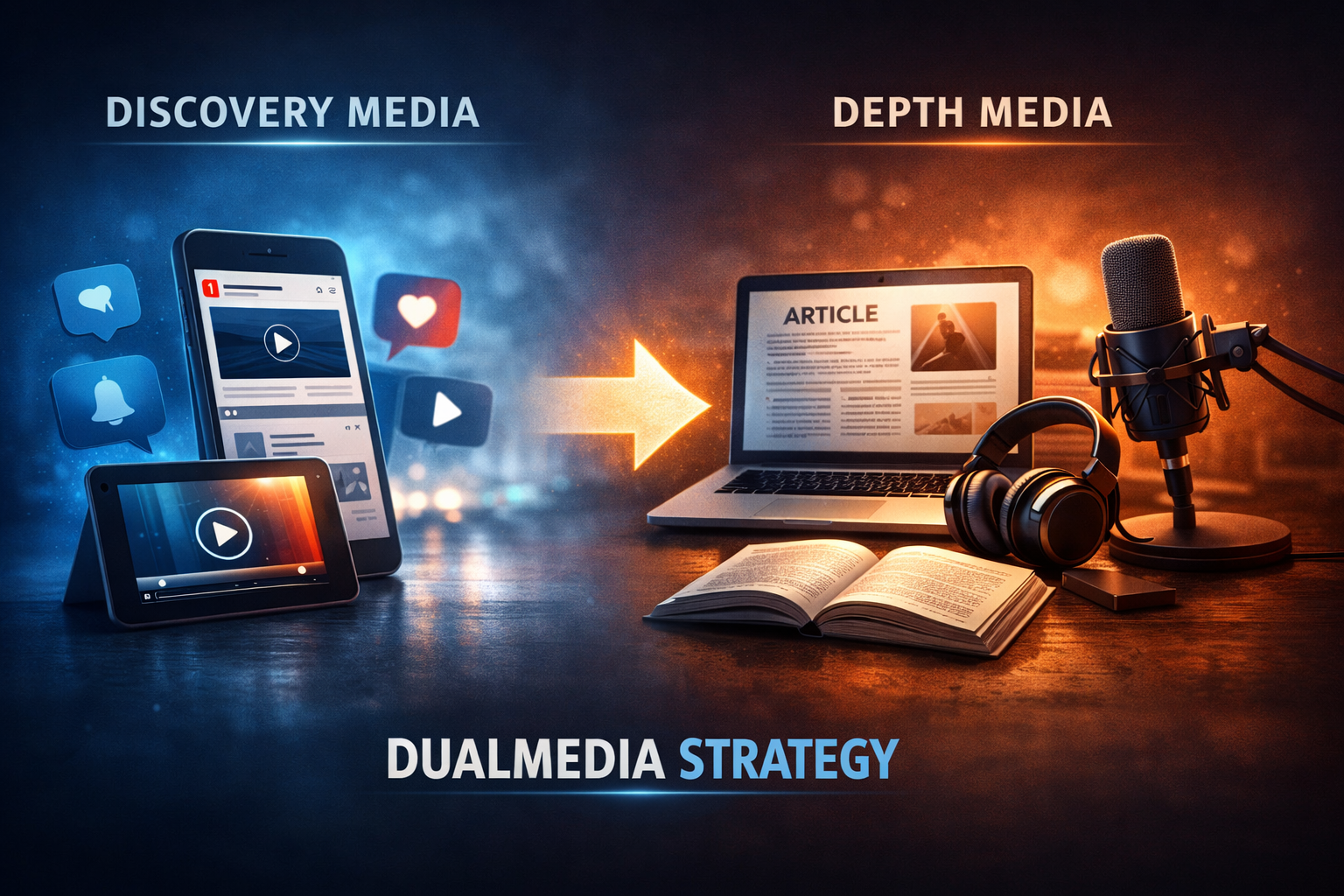
Discovery media are platforms where audiences encounter new information quickly. These often include social media feeds, short video platforms, push notifications, or visual posts.
They operate like the lobby of a large game server — the place where players first gather and notice what’s happening.
Depth media, by contrast, provide the full experience. These are long-form articles, podcasts, live discussions, or detailed guides where the entire story unfolds.
The strategy succeeds when discovery media creates curiosity and directs audiences toward depth media for the complete narrative.
Coordinated Messaging
A common mistake in digital communication is repeating identical content across platforms. Dualmedia Strategy avoids that trap by designing each piece of media for its environment.
A discovery post might highlight a single insight or moment. The depth content explains the full context.
The two pieces work together like a trailer and a full release. One grabs attention; the other delivers substance.
This coordinated approach ensures consistency while still respecting how people consume information on different platforms.
Audience Flow
Another defining feature of the strategy is intentional audience movement.
Instead of treating platforms as isolated islands, communicators create clear pathways between them.
A social clip leads to an article.
An article links to a podcast.
A livestream directs viewers to a deeper breakdown.
This flow mirrors how modern audiences naturally move between devices and platforms. The difference is that the journey is designed rather than accidental.
How Dualmedia Strategy Changes the Audience Experience
For audiences, the biggest benefit is clarity.
When communication is scattered or repetitive, people often receive fragments of a message without the context needed to understand it fully. Dualmedia Strategy reduces that confusion by structuring the information journey.
Someone might first see a quick highlight on social media — a statistic, a quote, or a short explanation. If they want more detail, the system directs them toward a deeper resource.
From the audience perspective, the experience feels intuitive.
It’s similar to how players approach a major update in a live-service game. First comes the announcement trailer. Then a developer blog provides detailed patch explanations. Finally, community streams or guides break down strategies and implications.
Each layer adds more understanding without overwhelming the player at the start.
In communication, Dualmedia Strategy replicates that layered discovery model.
The Role of Technology and Platforms
Technology has played a major role in the rise of Dualmedia Strategy.
Content distribution systems, analytics platforms, and social algorithms now provide detailed insights into how audiences move between channels. Communicators can see which discovery posts drive traffic, which formats hold attention, and where audiences drop off.
This data allows teams to refine the balance between discovery and depth media.
Another factor is the explosion of content formats. A single message today can exist as a written article, a short video clip, a podcast segment, and an interactive discussion thread.
Instead of treating these formats separately, Dualmedia Strategy integrates them into a unified communication structure.
In other words, the message becomes a multi-format ecosystem rather than a single piece of content.
Implications for Media, Brands, and Communities
The impact of Dualmedia Strategy extends beyond marketing departments. Newsrooms, online communities, and content creators are increasingly adopting similar frameworks.
For news organizations, the model helps balance speed and credibility. Quick updates on social platforms can alert audiences to breaking developments, while detailed reports provide verification and deeper analysis.
For brands and publishers, the approach helps maintain engagement without sacrificing substance. A campaign can reach wide audiences while still offering meaningful information for those who want to go further.
Community-driven spaces also benefit. Forums, livestream chats, and discussion groups often become the final stage of the dualmedia pipeline — the place where audiences interpret and debate the message together.
In many ways, this mirrors the culture of gaming communities where announcements, patch notes, and player analysis all coexist across different platforms.
Developer and Industry Direction
Looking ahead, the Dualmedia Strategy is likely to become even more structured.
Artificial intelligence tools are already helping communicators adapt content for multiple formats quickly. An article can generate summary clips, visual highlights, or short-form explanations designed for discovery platforms.
At the same time, audiences are becoming more selective about where they invest attention. This makes the depth component of the strategy even more important.
Quick exposure might attract viewers, but long-term trust grows through detailed and transparent communication.
Many organizations are also experimenting with interactive depth media — live Q&A sessions, community-driven articles, and multimedia storytelling that invite audiences to engage rather than simply read or watch.
In effect, the strategy continues evolving from a simple two-channel model into a broader communication ecosystem.
Conclusion
The rise of Dualmedia Strategy reflects a simple but powerful insight about modern communication: audiences discover information quickly, but they understand it slowly.By combining discovery media with depth media, organizations can guide people through both stages of that process. The first channel captures attention, while the second provides the clarity and context needed for real understanding. What makes the strategy effective is not just the use of multiple platforms but the intentional coordination between them. Messages are designed for each environment while still forming part of a single narrative.As digital ecosystems grow more crowded and attention becomes harder to earn, this structured approach offers a practical path forward. For communicators, publishers, and communities alike, Dualmedia Strategy represents less noise and more meaningful connection — a communication system built for the way audiences actually consume information today.
