
A Mid-Pacific Decision That Changed the Flight Plan
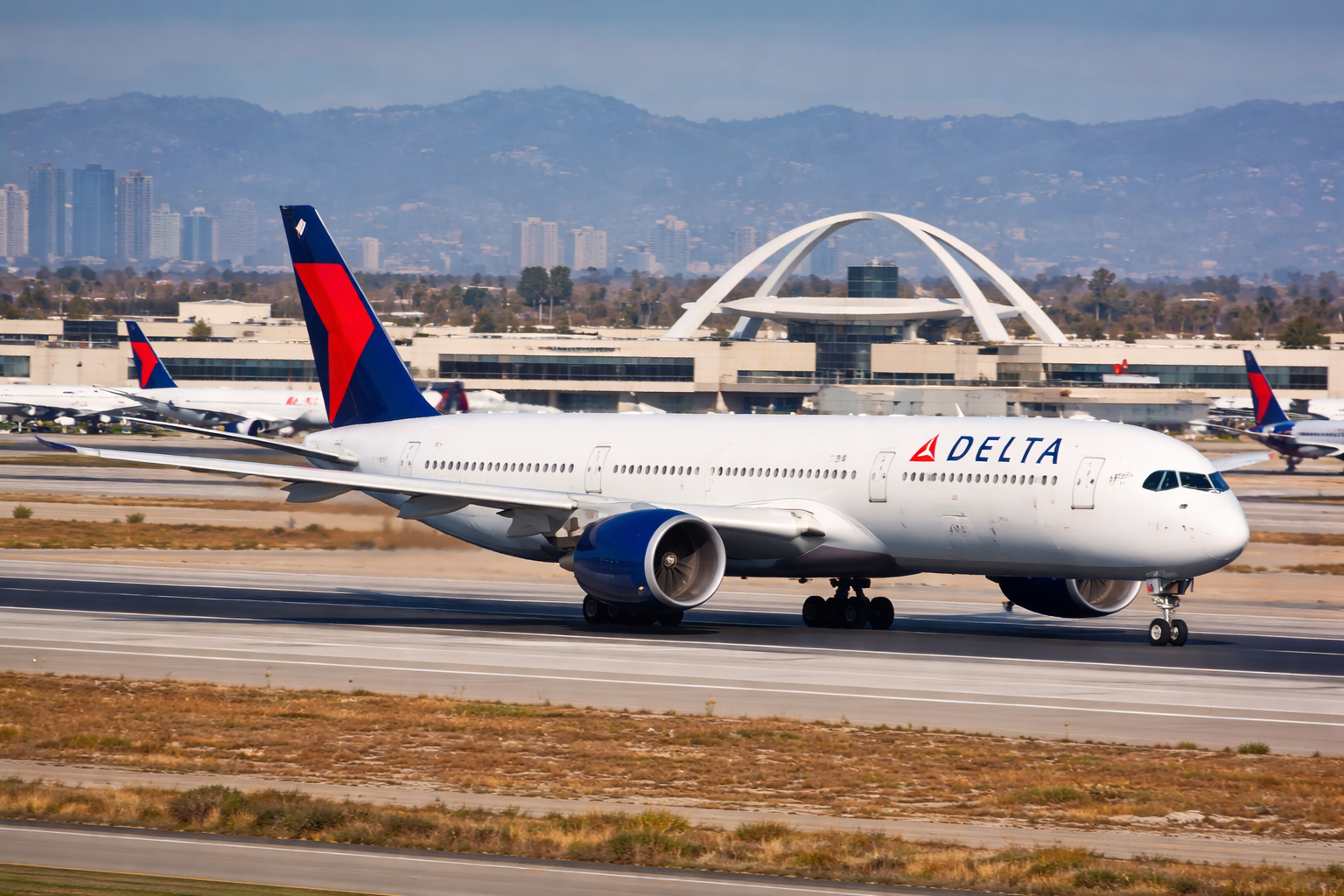
Long-haul flights rarely make dramatic course changes. When they do, it immediately catches the attention of aviation watchers and travelers alike. That’s exactly what happened with Delta Flight DL275, a regularly scheduled trans-Pacific service from Detroit to Tokyo.
The flight departed from Detroit Metropolitan Wayne County Airport expecting a typical 13-hour journey across the Pacific. Instead, hours into the trip, the aircraft made an unexpected decision: it turned away from Tokyo and redirected toward Los Angeles. The move transformed what should have been a direct Detroit-to-Japan route into a long detour that ended on the U.S. West Coast.
While passengers onboard experienced confusion and uncertainty, the decision was far from random. Flight crews were responding to a technical alert involving a critical engine system. Rather than continue across one of the world’s most remote flight corridors, pilots chose the safer option — diverting to a major airport equipped to handle the aircraft and any potential repairs.
The incident involving Delta Flight DL275 quickly became a talking point in aviation circles because it illustrated how modern airline operations prioritize caution over convenience, even when the disruption is costly and complex.
Why This Incident Matters in Modern Aviation
To the average traveler, a diversion might feel like a major failure. In reality, it often represents the opposite.
Modern aircraft like the Airbus A350 are equipped with extensive monitoring systems. Sensors track engine performance, environmental conditions, and hundreds of mechanical variables in real time. When something falls outside safe parameters, the cockpit receives alerts that guide decision-making.
In the case of Delta Flight DL275, the issue involved the aircraft’s engine anti-ice system, a component that prevents ice from forming on engine parts during high-altitude flight. Without proper functioning of this system, ice buildup could disrupt airflow or reduce engine efficiency in extremely cold conditions.
On a short domestic flight, a crew might continue to the destination if conditions allow. But a trans-Pacific route is different. Once an aircraft commits to crossing the ocean, diversion options become limited. Airports are sparse, distances are massive, and weather conditions can shift quickly.
That context explains why the crew’s decision to divert was so decisive. Rather than risk flying thousands more miles over open water, they redirected the aircraft toward Los Angeles, a major hub with the facilities needed for inspection and repair.
In aviation terms, this wasn’t panic. It was protocol.
What Happened During the Flight
The timeline of Delta Flight DL275 reveals how carefully these situations are handled.
The Airbus A350-900 departed Detroit normally and climbed to cruising altitude over the North Pacific. Several hours into the flight, cockpit systems flagged an anomaly in the engine anti-ice system connected to one of the Rolls-Royce Trent XWB engines.
At roughly 38,000 feet, about 620 nautical miles southwest of Anchorage, the crew assessed the warning and began coordinating with air traffic control and airline operations. Continuing toward Tokyo would have meant committing to a long stretch of oceanic airspace.
Instead, the aircraft altered course and headed southeast toward Los Angeles International Airport.
From there, the situation played out calmly but methodically:
The aircraft continued flying for several more hours toward LAX, where maintenance teams and support staff were ready. The flight eventually landed safely after more than 12 hours in the air — nearly the same duration as the planned Detroit-Tokyo trip.
No injuries were reported, and passengers disembarked normally.
Delta technicians then inspected the aircraft while airline staff worked to rebook travelers on alternative flights to Tokyo.
In many ways, the most remarkable detail of the story is how uneventful the landing was. For passengers, the biggest disruption was scheduling — not safety.
The Passenger Experience During the Diversion
From the perspective of travelers onboard Delta Flight DL275, the situation likely felt strange rather than frightening.
Long-haul flights are usually quiet routines. Passengers settle into entertainment systems, meals arrive in stages, and cabin lighting gradually shifts to mimic time zones. A sudden course change disrupts that rhythm.
Reports from aviation coverage suggest that the atmosphere shifted once the diversion announcement came from the cockpit. People checked flight maps, watched the aircraft’s route bend toward California, and began wondering what would happen next.
The experience wasn’t chaotic, but it was unusual.
For travelers heading to Tokyo for business meetings, vacations, or connecting flights, the diversion meant delays and overnight adjustments. Airlines typically respond by arranging hotel accommodations, meal vouchers, and rebooking assistance — a logistical effort involving hundreds of passengers.
This is the behind-the-scenes part of aviation most people never see.
When a wide-body aircraft diverts unexpectedly, airlines must quickly rework travel plans across multiple routes and time zones. Seats on alternative flights need to be found, luggage must be rerouted, and customer service teams handle dozens of individual situations.
For Delta Flight DL275, the airline canceled the remaining portion of the trip to Tokyo and transferred passengers onto other available services.
It’s inconvenient, but it’s part of the industry’s contingency playbook.
The Technology Behind the Decision
The Airbus A350-900, the aircraft used on DL275, is considered one of the most advanced long-haul jets currently flying. It generates enormous amounts of operational data during every flight, allowing engineers and pilots to monitor systems in real time.
Ironically, that advanced technology is often what triggers diversions like this.
Aircraft systems today are designed to detect irregularities extremely early. A warning may appear long before a problem becomes serious. That early detection gives pilots the option to divert safely rather than deal with a larger issue later.
The engine anti-ice system that caused the alert on Delta Flight DL275 plays a particularly important role during high-altitude flight over cold regions. Ice buildup in engine inlets can affect airflow and performance, especially during extended flights across colder climates.
Because the Detroit-Tokyo route passes through some of the coldest upper-atmosphere regions on Earth, the system is essential.
When it flagged an abnormal reading, the safest move was to land somewhere with full maintenance capability.
Los Angeles offered exactly that.
The Operational Cost Behind a Safety Decision
While safety decisions always come first, diversions like the Delta Flight DL275 incident are expensive.
Airlines must account for fuel costs, landing fees, aircraft inspections, crew scheduling changes, and passenger compensation. Industry estimates suggest a major diversion involving a wide-body aircraft can cost millions of dollars once everything is factored in.
In this case, the aircraft itself remained grounded for inspection before returning to service roughly a day later.
But airlines accept these costs as part of their safety philosophy.
Modern aviation culture emphasizes proactive action. If a system shows unusual behavior, crews act immediately rather than waiting for confirmation of a larger issue.
It’s a cautious approach — and one that has helped make commercial aviation statistically one of the safest forms of transportation in the world.
What This Incident Says About Aviation’s Future
The Delta Flight DL275 incident also highlights a growing trend in aviation: predictive maintenance and data-driven safety systems.
Modern aircraft generate enormous volumes of sensor data every flight. Engineers are increasingly using machine learning tools to analyze that information and identify patterns before mechanical problems appear.
In theory, future systems may detect anomalies hours — or even days — before a flight departs.
That could prevent diversions entirely.
But even with advanced analytics, real-time monitoring remains essential. Aircraft operate in constantly changing conditions, from weather shifts to mechanical stress during long flights.
Diversions like DL275 remind us that aviation safety relies on a layered approach: technology, trained crews, and conservative decision-making.
Conclusion
The story of Delta Flight DL275 is not about a disaster narrowly avoided. Instead, it’s a case study in how modern aviation handles uncertainty.A technical alert involving an engine anti-ice system prompted the crew to make a careful call: abandon the original Detroit-to-Tokyo route and divert to Los Angeles for inspection. The aircraft landed safely, passengers were rebooked, and the plane returned to service after maintenance checks.For travelers, the incident meant delays and unexpected itinerary changes. For the aviation industry, it demonstrated something more important — the system working exactly as designed.Diversions may feel dramatic from the outside, but in reality they represent a culture built around prevention. When a potential issue appears, pilots act early and decisively.In the case of Delta Flight DL275, that decision turned a routine flight into an unexpected story — and a reminder of how carefully modern air travel is managed.
