
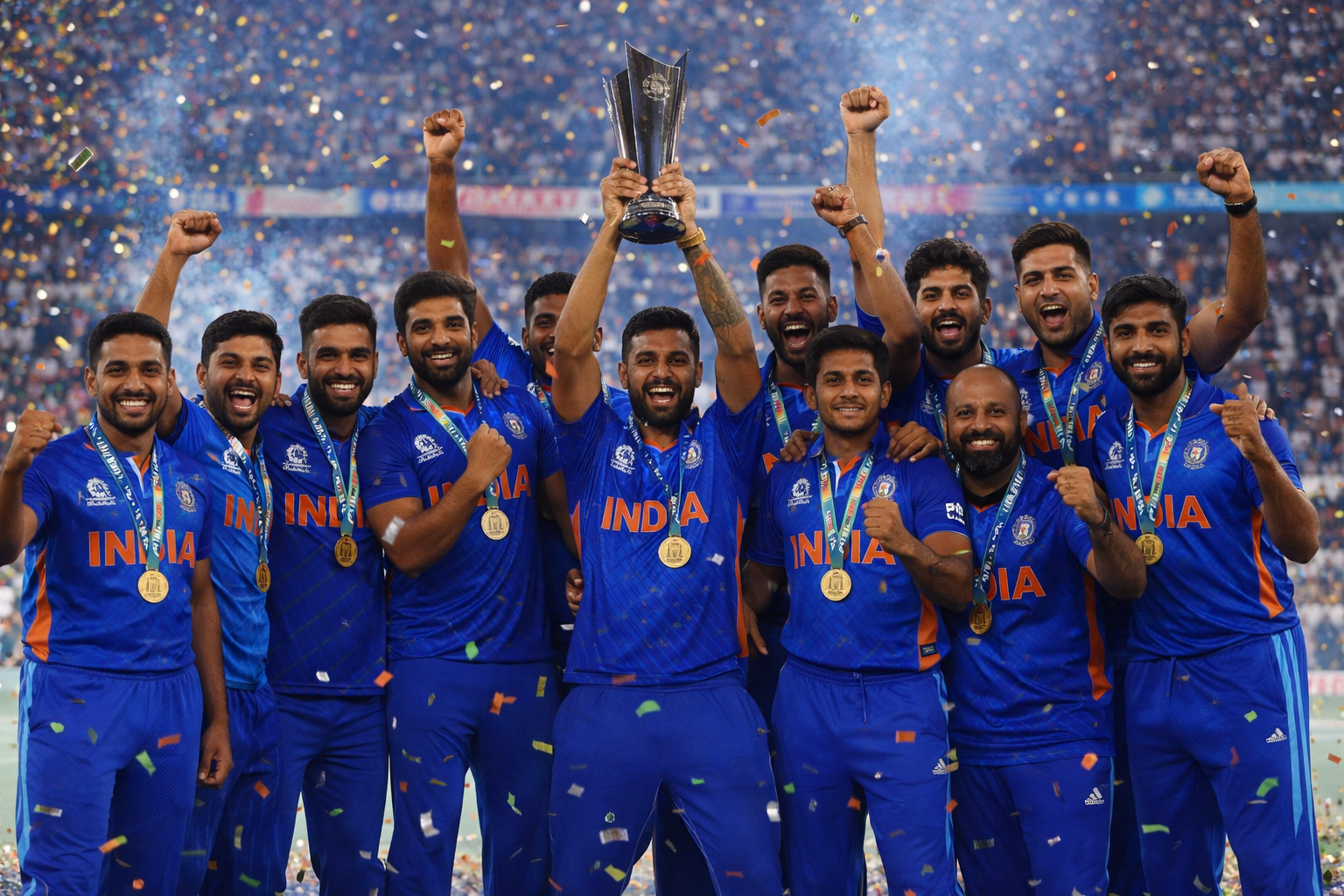
A Historic Triumph in Ahmedabad
March 8, 2026, will remain a historic date in Indian cricket. On this day, the Indian cricket team delivered a commanding performance to defeat New Zealand by 96 runs in the ICC Men’s T20 World Cup 2026 final at the iconic Narendra Modi Stadium in Ahmedabad. With this victory, India secured its third T20 World Cup title, making history as the first team to defend the trophy successfully.
The final wasn’t just a match; it was a statement. India’s innings posted a staggering 255/5 in 20 overs, establishing the highest total ever recorded in a T20 World Cup final. New Zealand’s chase never found momentum, collapsing to 159 all out in 19 overs. The 96-run margin underscored India’s dominance in all departments of the game — batting, bowling, and fielding. For fans and cricket analysts alike, it was a masterclass in limited-overs cricket strategy, skill execution, and mental toughness.
The Significance of This Win
India’s victory carries layers of significance. Beyond the immediate glory of lifting the trophy, the win reflects the evolution of the team’s approach to T20 cricket. In the past decade, T20 cricket has seen an arms race of batting firepower, innovative shots, and ever-increasing strike rates. Yet, despite the allure of explosive batting alone, tournament victories still require a balance between aggression and tactical discipline. India demonstrated precisely that.
Historically, the Narendra Modi Stadium has been a venue of mixed fortunes for India. The heartbreak of the 2023 ODI World Cup final loss loomed large in memory. Returning to the same ground and claiming a title of this magnitude served not just as a trophy win but as symbolic redemption. It was a vindication of India’s current cricketing philosophy — one that blends youth with experience, aggression with intelligence, and flair with strategy.
Furthermore, this victory positions India as a benchmark for sustained success in T20 cricket. While past champions often relied on fleeting brilliance, India’s approach in 2026 emphasized consistency, adaptability, and psychological resilience, setting an example for teams worldwide.
Tournament Journey: From Group Stages to Glory
India entered the T20 World Cup 2026 as defending champions, carrying the weight of expectations. The tournament began with high-pressure matches in diverse conditions, testing every facet of the team. Early group-stage matches highlighted India’s dual strengths: aggressive top-order batting and disciplined, tactical bowling.
Key moments included a nail-biting win against Pakistan, where a last-over six sealed the game, and a challenging encounter with Australia, where India defended a modest total thanks to tactical bowling changes and sharp fielding. These early tests built confidence and cohesion, preparing India for the high-stakes knockout phase.
In the semifinals, India faced England in what many considered a must-win thriller. England’s formidable pace attack and adaptable middle order made the chase intimidating. However, India’s bowlers executed the perfect plan under pressure, defending the target successfully. These matches not only honed India’s skills but also reinforced the mental toughness that would define their performance in the final.
The Final: India vs. New Zealand
Toss and Initial Strategy
New Zealand captain Mitchell Santner won the toss and elected to bowl, aiming to restrict India early and chase under favorable lights. This decision, however, backfired. India immediately took control, showcasing their intent with aggressive strokeplay and intelligent rotation of strike. The powerplay overs became a showcase of tactical excellence and explosive batting.
India Innings – 255/5 (20 Overs)
| Batsman | R | B | 4s | 6s | SR |
|---|---|---|---|---|---|
| Sanju Samson (wk) | 89 | 46 | 5 | 8 | 193.48 |
| Abhishek Sharma | 52 | 21 | 6 | 3 | 247.62 |
| Ishan Kishan | 54 | 25 | 4 | 4 | 216.00 |
| Hardik Pandya | 18 | 13 | 1 | 1 | 138.46 |
| Suryakumar Yadav (c) | 0 | 1 | 0 | 0 | 0.00 |
| Tilak Varma (not out) | 8 | 6 | 0 | 0 | 133.33 |
| Shivam Dube (not out) | 26 | 8 | 3 | 2 | 325.00 |
| Extras | 8 | ||||
| Total | 255/5 | 20.0 ov |
Did not bat: Axar Patel, Arshdeep Singh, Varun Chakravarthy, Jasprit Bumrah.
India’s innings was a blend of audacity and discipline. Abhishek Sharma and Ishan Kishan launched an aggressive assault in the opening overs, taking the game away from New Zealand before the powerplay had ended. Sanju Samson’s 89, paced with intelligence, ensured momentum never faltered. Late cameos from Shivam Dube and Tilak Varma added critical runs in the final overs, pushing the total to a daunting 255.
New Zealand Innings – 159 All Out (19 Overs)
| Batsman | R | B | 4s | 6s |
|---|---|---|---|---|
| Tim Seifert | 52 | 26 | 2 | 5 |
| Finn Allen | 9 | 7 | 1 | 0 |
| Rachin Ravindra | 1 | 2 | 0 | 0 |
| Glenn Phillips | 5 | 5 | 1 | 0 |
| Mark Chapman | 3 | 8 | 0 | 0 |
| Daryl Mitchell | 17 | 11 | 0 | 2 |
| Mitchell Santner | 43 | 35 | 3 | 2 |
| James Neesham | 8 | 7 | 1 | 0 |
| Matt Henry | 0 | 1 | 0 | 0 |
| Lockie Ferguson (not out) | 6 | 7 | 0 | 0 |
| Jacob Duffy | 3 | 5 | 0 | 0 |
| Total | 159/10 (19.0 ov) |
Jasprit Bumrah’s devastating spell of 4/15 shattered New Zealand’s chase, with Axar Patel taking crucial wickets to ensure no partnership could flourish. Brief resistance came from Tim Seifert (52) and Mitchell Santner (43), but it was never enough against India’s relentless attack. The early collapse set the tone, and wickets fell steadily throughout the innings.
Key Tactical Observations
- Aggressive Powerplay Execution: India’s opening strategy was flawless, applying pressure while minimizing risk.
- Depth in Batting Lineup: The middle order seamlessly absorbed pressure and accelerated in the final overs.
- Death Bowling Mastery: Bumrah and Patel executed variations and field placements with surgical precision.
- Mental Composure: Despite high stakes and record chase pressures, India maintained calm, making intelligent decisions throughout.
Player Performances and Impact
Sanju Samson: The backbone of India’s innings. Balanced attack and pacing of 89 runs showcased his ability to dominate a world-class bowling attack under pressure.
Abhishek Sharma & Ishan Kishan: Explosive starts that established dominance in the first six overs. Their aggressive intent forced New Zealand into reactive strategies.
Jasprit Bumrah: Redefined death bowling in T20 finals. Precision and variation dismantled New Zealand’s chase and emphasized the importance of controlled aggression.
Tim Seifert & Mitchell Santner: Provided some resistance for New Zealand, showing that skill alone was not sufficient against India’s collective performance.
Broader Implications for T20 Cricket
India’s victory sets a template for modern T20 success:
- Balanced aggression and strategy remain crucial. Explosive batting alone cannot secure a championship.
- All-round depth is essential. Teams with strong bench strength and multi-role players have a higher chance of success.
- Psychological resilience is a differentiator. India’s ability to perform under pressure underscores preparation, planning, and mental conditioning.
- Death overs precision: Tactical execution in the final five overs can define matches, as demonstrated by Bumrah.
The global T20 landscape will closely analyze India’s approach, blending youth development, coaching, and match tactics.
Historical Context and Significance
India’s win adds another chapter to a storied history in ICC tournaments. Having already claimed T20 World Cup titles in 2007 and 2024, this 2026 victory completes a historic three-peat, a feat no other nation has achieved. It also represents India’s first successful defense of a T20 World Cup title, cementing the team’s status as the benchmark in limited-overs cricket.
Future Directions for India
With emerging talents like Abhishek Sharma, Tilak Varma, and seasoned veterans like Bumrah, Suryakumar Yadav, and Hardik Pandya, India has a balanced roster poised for sustained success. Lessons from this tournament, including pressure handling, flexible strategy implementation, and high-tempo execution, will influence domestic leagues, international tours, and future World Cups.
The team now serves as a model for global T20 cricket: blending youth, experience, aggression, and tactical intelligence.
Conclusion
The ICC Men’s T20 World Cup 2026 final showcased everything modern T20 cricket aspires to be: explosive innings, intelligent bowling, strategic field placements, and mental toughness under pressure. India’s 255/5 and 96-run victory over New Zealand wasn’t just a win; it was a demonstration of preparation, skill, and execution at the highest level.This historic triumph — India’s third T20 World Cup title and first successful title defense — defines the blueprint for T20 success: balance, aggression, adaptability, and resilience. India has set a benchmark, not only for this tournament but for the future of world cricket.
