
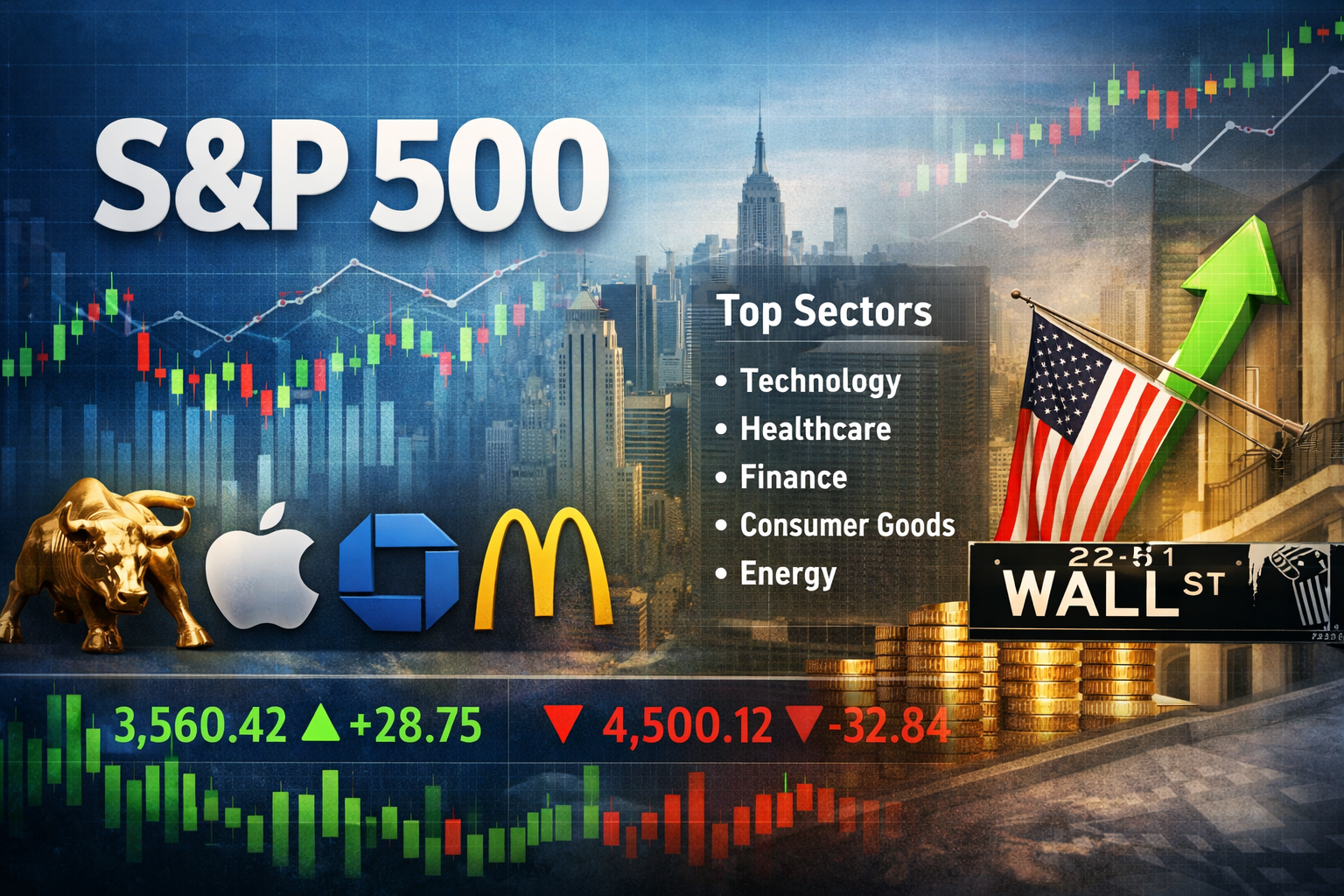
The SP500 Explained topic matters because few market benchmarks shape investor conversations more than the S&P 500. Whether someone is checking retirement performance, watching financial news, or comparing mutual funds, this index keeps showing up for a reason. It is often treated as a quick snapshot of how large U.S. companies are doing, but that simple description only tells part of the story.
For new investors, the S&P 500 can feel like a mysterious number on a screen. For experienced investors, it is often the standard against which everything else gets judged. Understanding what it is, how it works, and why it matters can make the broader stock market feel a lot less confusing.
What Is the S&P 500?
The S&P 500, short for Standard & Poor’s 500, is a stock market index made up of 500 of the largest publicly traded companies in the United States.
That sounds straightforward, but the index is not just a random list of big businesses. It is designed to reflect the performance of large-cap U.S. stocks across major sectors of the economy, including technology, healthcare, financials, consumer goods, energy, and more.
When people say, “The market was up today,” they are often referring—directly or indirectly—to the S&P 500.
Why the S&P 500 matters
It is widely seen as one of the best broad gauges of the U.S. stock market because it includes companies that touch everyday life:
- Banks
- Tech giants
- Drugmakers
- Retailers
- Manufacturers
- Energy companies
That broad exposure is exactly why so many investors, analysts, and fund managers pay attention to it.
SP500 Explained: Why It Is More Than Just a Number
If you only look at the S&P 500 as a daily percentage gain or loss, you miss its real value.
The index is often used as:
- A market barometer
- A benchmark for fund performance
- A proxy for investor sentiment
- A long-term wealth-building reference point
For example, if a mutual fund manager says they “beat the market,” the comparison is often against the S&P 500. If they underperform it over several years, investors may start asking hard questions.
That is one reason the index matters beyond headlines—it shapes decisions, fees, expectations, and even reputations.
How the S&P 500 Is Built
A common misunderstanding is that the S&P 500 simply includes the 500 biggest U.S. companies by market value. Size matters, but that is not the full rule.
Companies must meet certain criteria
To be included, a company typically needs to meet standards such as:
- Being based in the United States
- Having a large market capitalization
- Having enough shares available for public trading
- Showing strong liquidity
- Meeting profitability requirements
This matters because the index aims to include companies that are not only large, but also actively traded and financially established.
It is not equal-weighted
The S&P 500 is a market-cap-weighted index.
That means bigger companies have a bigger impact on the index than smaller ones. If a giant company rises sharply, it can move the index more than several smaller companies combined.
Simple example
Imagine two companies in the index:
- Company A is worth $2 trillion
- Company B is worth $50 billion
If both stocks move 5%, Company A will have a much larger effect on the S&P 500.
This is why a handful of mega-cap stocks can sometimes heavily influence index performance, especially during strong tech rallies or selloffs.
Why Investors Watch the S&P 500 So Closely
The answer is simple: it gives a fast, practical read on where large U.S. stocks are heading.
But there are several deeper reasons.
1. It Reflects Broad Economic Confidence
The S&P 500 includes companies tied to consumer spending, business investment, healthcare demand, banking activity, and industrial production.
When the index rises steadily, it often suggests investors feel confident about:
- Corporate earnings
- Economic growth
- Consumer demand
- Interest rate stability
When it falls sharply, fear is often entering the market—sometimes because of recession concerns, inflation, geopolitical shocks, or policy changes.
That does not mean the index predicts the economy perfectly. Markets can move ahead of economic data, and sometimes they get things wrong. Still, it remains one of the most watched signals of financial confidence.
2. It Is the Benchmark Most Funds Are Judged Against
This is one of the most practical reasons investors care.
If you own:
- A retirement account
- A mutual fund
- A managed portfolio
- A large-cap ETF
There is a good chance someone is comparing that investment to the S&P 500.
If a fund charges high fees but regularly trails the index, investors may wonder whether they would be better off owning a low-cost index fund instead.
That simple comparison has changed the investment industry over the last two decades. Passive investing grew in part because many active managers struggled to beat the S&P 500 consistently after fees.
3. Many People Invest in It Directly
You cannot buy the index itself as a single stock, but you can invest in S&P 500 index funds and ETFs that track it.
That makes it one of the most accessible investment vehicles in the world.
Popular reasons people choose S&P 500 funds include:
- Broad diversification
- Lower fees
- Simplicity
- Long-term historical growth potential
- Less need to pick individual stocks
For many everyday investors, owning an S&P 500 fund is not just a strategy—it is the strategy.
SP500 Explained for Beginners: Is It the Same as “The Stock Market”?
Not exactly.
The S&P 500 is often used as shorthand for the stock market, but it is only one slice of it.
What it includes
- Large U.S. companies
What it does not fully include
- Small-cap stocks
- Many mid-cap stocks
- Foreign companies
- Private companies
- Bonds
- Real estate
- Commodities
So while it is a strong indicator of large-cap U.S. equity performance, it is not the entire investing universe.
That distinction matters. A year when the S&P 500 does well may not mean international stocks, small caps, or bonds did well too.
The S&P 500 vs. Other Major Indexes
To understand why the S&P 500 gets so much attention, it helps to compare it with other indexes.
S&P 500 vs. Dow Jones Industrial Average
The Dow is older and famous, but it includes only 30 companies.
It is also price-weighted, which means stock price—not company size—affects influence. That can produce odd distortions.
The S&P 500 is usually considered more representative of the U.S. large-cap market.
S&P 500 vs. Nasdaq Composite
The Nasdaq Composite includes many more companies and has a stronger technology tilt.
When tech is booming, the Nasdaq may outperform sharply. When tech struggles, it can fall harder.
The S&P 500 tends to offer a more balanced view across sectors.
S&P 500 vs. Russell 2000
The Russell 2000 tracks smaller U.S. companies.
It is often used to gauge risk appetite and domestic economic sensitivity, since small businesses can react differently to interest rates and credit conditions.
What Moves the S&P 500?
The index moves every trading day, but the forces behind those moves are usually familiar.
Key drivers include:
Corporate earnings
If major companies report stronger-than-expected profits, the index often benefits.
Interest rates
When rates rise, borrowing gets more expensive and future profits are discounted more heavily. That can pressure stock valuations.
Inflation
Sticky inflation can make investors nervous because it may keep interest rates higher for longer.
Economic data
Jobs reports, GDP growth, retail sales, and manufacturing numbers all influence expectations.
Geopolitical events
Wars, trade disputes, and policy uncertainty can affect market sentiment quickly.
Sector concentration
Because the S&P 500 is market-cap weighted, large moves in mega-cap sectors—especially technology—can heavily influence the overall index.
Is the S&P 500 a Good Investment?
For many long-term investors, it has been a strong core holding. But “good” depends on goals, time horizon, and risk tolerance.
Why many investors like it
- Built-in diversification across 500 large companies
- Historically resilient over long periods
- Easy access through low-cost funds
- Less reliance on guessing which single stock will win
What investors should keep in mind
- It can still fall hard in bear markets
- It is concentrated in large U.S. companies
- It may become top-heavy during market manias
- Past performance is never a guarantee of future returns
A common mistake is assuming the S&P 500 is “safe” because it is diversified. It is less risky than owning a few individual stocks, but it is still an equity investment. It can decline sharply during recessions, crises, or valuation resets.
A Practical Way to Think About the S&P 500
If the stock market were a city skyline, the S&P 500 would be the view from the rooftop.
You can see the tallest, most important buildings. You get a strong sense of overall direction. But you do not see every side street, small business, or neighborhood.
That is why the S&P 500 is so useful—and why it still has limits.
It gives a clean, efficient read on large corporate America. It does not tell you everything about the economy, nor does it cover every investment opportunity. But for most people, it is still one of the best places to start.
Common Misunderstandings About the S&P 500
“It always goes up”
Over long periods, it has historically trended upward. Over shorter periods, it can be brutally volatile.
“It includes the 500 biggest companies only”
Not exactly. There are eligibility rules and committee decisions involved.
“If the S&P 500 is up, everyone made money”
Not true. Different sectors, asset classes, and individual portfolios can perform very differently.
“Owning the S&P 500 means total diversification”
It is diversified within U.S. large-cap stocks, but not across all global assets.
FAQ: SP500 Explained
Is the S&P 500 better than buying individual stocks?
For many investors, yes—especially if they want broad exposure without constantly researching companies. Individual stocks can outperform, but they also add more concentration risk.
Can beginners invest in the S&P 500?
Yes. Many beginners use low-cost S&P 500 ETFs or index funds because they are simple, diversified, and easy to hold long term.
Why does the S&P 500 sometimes rise even when the economy feels weak?
Markets look forward, not just at current conditions. Investors may expect future earnings, lower interest rates, or policy support before the economy visibly improves.
Does the S&P 500 include international companies?
Not in the usual sense. It focuses on major U.S. companies, though many of those businesses earn revenue globally.
How often does the S&P 500 change?
It is not static. Companies can be added or removed over time as they grow, shrink, merge, or no longer meet eligibility standards.
Final Thoughts
The S&P 500 remains one of the most important financial benchmarks because it sits at the intersection of investing, business performance, and public confidence. It matters to professionals because it is a standard. It matters to everyday investors because it is accessible. And it matters to the financial media because it captures, in one number, how large U.S. companies are being valued at any given moment.If you understand the S&P 500, you understand a large part of how modern investing is discussed—and why so many portfolios are built around it.
