
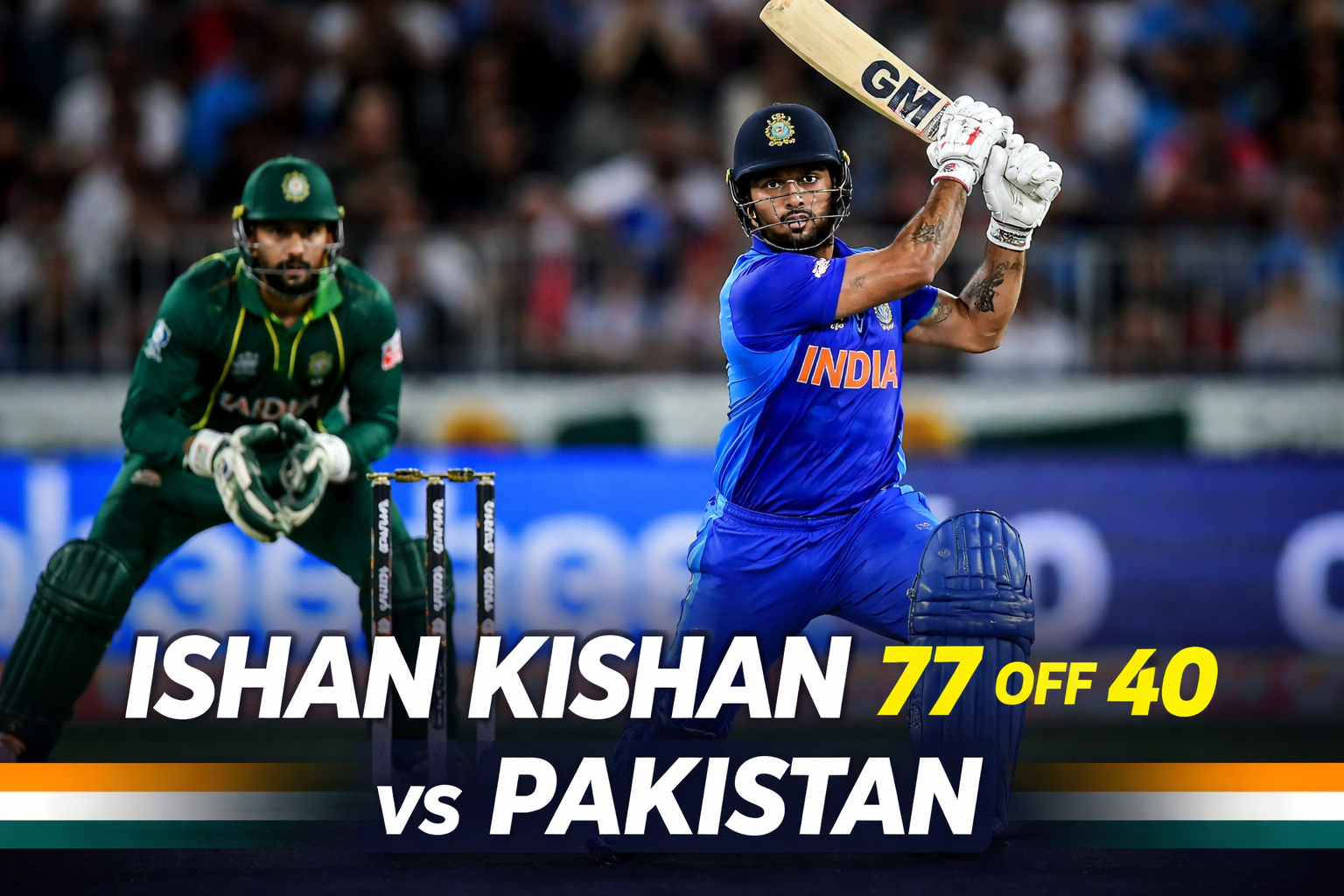
A long-standing weakness met its sharpest test on cricket’s biggest stage — and Ishan Kishan answered with one of the most controlled innings of the tournament. His 77 off 40 balls against the Pakistan national cricket team in the ICC Men’s T20 World Cup was more than a high-impact cameo. It was a calculated correction of a problem opponents had targeted for years.
Against an attack that historically forced errors from him, Kishan produced an innings built on technical adjustment, pacing, and situational awareness. India’s total — and eventually the margin of victory — traced directly back to how he handled the opening spell.
Early overs reveal a changed approach
Pakistan’s new-ball plan was predictable and disciplined. The bowlers attacked the corridor outside off stump, shaping the ball away from the left-hander and denying width. It was the exact template that had dismissed Kishan in previous meetings.
This time, the response was noticeably different.
Instead of driving on the rise, Kishan played late and close to his body. His bat swing was compact, and his head remained still through contact. The result was fewer false shots and better strike rotation in the powerplay.
Where earlier innings against similar bowling had stalled, this one accumulated quietly. Singles replaced risky drives. The scoreboard moved without visible panic.
Technical refinements under pressure
Broadcast replays highlighted a subtle change in stance. Kishan stood slightly more open, allowing him clearer access to the off side without reaching. That adjustment reduced the angle that had previously dragged his hands away from his body.
Equally important was shot selection. He avoided the expansive cover drive early, a stroke that had often invited edges. Instead, he targeted square boundaries and worked the ball behind point, forcing fielders to spread.
Once the ring opened, the scoring areas expanded.
His first burst of boundaries came not from improvisation but from patience. Pakistan missed length for a brief window, and Kishan capitalized immediately, clearing the infield and shifting momentum.
Middle overs acceleration shifts the match
After surviving the testing opening spell, Kishan transitioned into calculated attack. Change bowlers bore the brunt. He used depth in the crease to manipulate length and created scoring angles through placement rather than raw power.
The acceleration arrived in phases. A boundary would follow a quiet over, preventing pressure from building. Partnerships remained intact, and India avoided the collapse that often defines high-stakes T20 contests.
Field adjustments from Pakistan signaled the shift in control. Defensive placements appeared earlier than expected, conceding singles that kept the run rate healthy.
By the time Kishan crossed fifty, India had established a platform that allowed the lower order to play with freedom.
Game awareness defines the innings
Beyond technique, the innings reflected strong match awareness. Kishan read bowling patterns quickly and resisted predictable traps. When Pakistan stacked the off side, he nudged singles rather than forcing aerial shots.
That discipline disrupted bowling rhythms. T20 plans depend on repetition; Kishan denied bowlers the comfort of predictable responses.
He also managed tempo effectively. There were no extended stretches of dot balls, but equally no reckless overs that risked collapse. The balance kept India ahead without exposing the middle order prematurely.
Preparation meets execution
Team analysts had identified Pakistan’s preferred lines well before the match. Training sessions reportedly focused on hard-length deliveries and seam movement, simulating the conditions Kishan would face.
What stood out was the transfer of practice into match behavior. His scoring zones looked premeditated. Even mistimed strokes traveled into relatively safe areas, suggesting clear pre-match planning.
At the international level, preparation only matters if it survives pressure. Kishan’s innings suggested strong mental rehearsal alongside technical work.
Turning vulnerability into advantage
Perhaps the most striking element of the knock was how a former weakness became a scoring opportunity. Deliveries outside off stump — once a danger zone — were steered deliberately into gaps.
Rather than avoiding the channel, Kishan redesigned how he attacked it. The adjustment flipped the contest psychologically. Bowlers searching for his old mistake found a batter in control.
That shift forced Pakistan to explore alternative lengths, which in turn opened areas he naturally favors on the leg side.
Impact on the contest
India’s final total reflected the stability provided at the top. Without Kishan’s control against the new ball, the innings could have unraveled early. Instead, the platform allowed a strong finish and scoreboard pressure that Pakistan never fully escaped.
Captains value innings that absorb risk while maintaining tempo. This knock did both. It neutralized Pakistan’s strongest phase and transferred pressure back to the chasing side.
In tournament cricket, those swings often decide outcomes more than isolated moments of brilliance.
Broader significance
For Kishan, the innings represents an evolution in reputation. He has long been viewed as a high-risk aggressor. This performance added a layer of adaptability and tactical maturity.
Opposition teams will reassess their plans. Match-ups in T20 cricket are fluid; once a weakness closes, bowlers must search for the next opening. The cycle of adjustment continues.
India’s team management, meanwhile, gains reassurance that its top order can absorb elite bowling without abandoning intent. That balance is critical in knockout stages, where early wickets frequently define results.
FAQ
Why was this innings considered tactically important?
It neutralized Pakistan’s strongest bowling phase and prevented early collapse. That stability allowed India to control the game’s tempo from the powerplay onward.
What specific weakness did Kishan address?
He had struggled against tight off-stump seam bowling. In this match, he played later and reduced risky drives, turning that channel into a scoring option.
Did Pakistan change tactics during the innings?
Yes. Once off-side pressure failed to produce wickets, they adjusted fields and lengths, which opened scoring areas Kishan exploited.
How does this affect future match-ups?
Opponents will study the adjustments and develop counters. T20 cricket is a constant cycle of adaptation on both sides.
Was the pitch a major factor?
The surface offered good bounce, but the innings was shaped more by shot selection and discipline than by conditions alone.
