
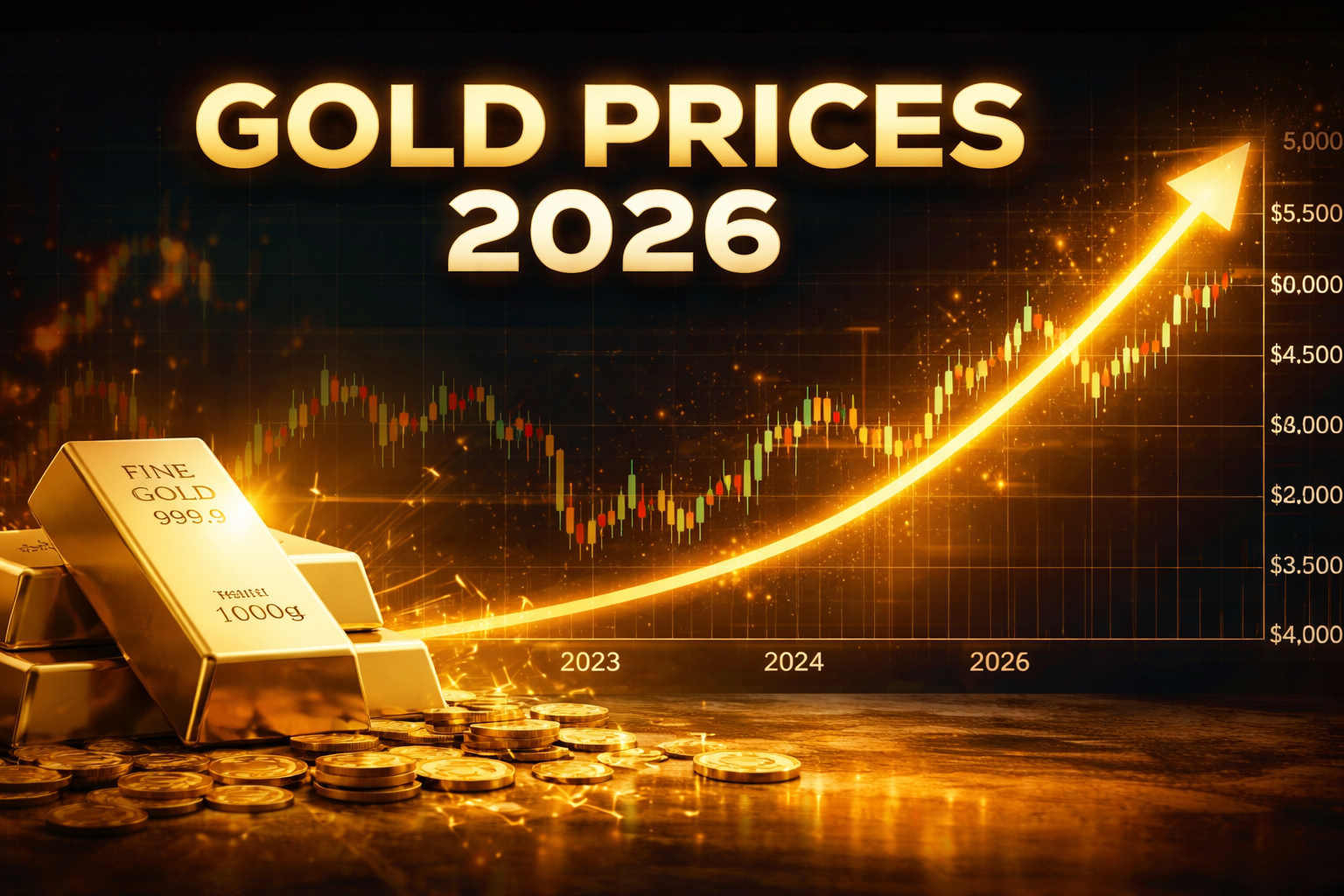
Gold prices in 2026 are no longer a minor talking point confined to commodity traders and bullion dealers. What has emerged this year is a narrative that feels almost seismic in the world of global finance. After years of steady demand and occasional rallies tied to market stress, the price of gold has climbed into territory that, only a few years ago, would have seemed bold or speculative. As of early 2026, bullion is trading consistently above levels that suggest not just cyclic strength but structural change in how markets price and value this timeless asset.
Across global exchanges, from London to New York to Shanghai, markets are reflecting a shared belief that gold has crossed a threshold. It isn’t swinging wildly on headlines alone; it is building a base supported by macroeconomic forces, shifting investor behavior, central bank strategies and the enduring appeal of a safe store of value. This shift is significant because gold, unlike growth stocks or volatile crypto assets, rarely moves purely on emotion. Its price rises and falls with the undercurrents of global monetary policy, currency valuation and geopolitical risk.
To understand why gold prices in 2026 are capturing attention at such a scale, we need to explore not just the numbers but the forces behind them. The story of gold in 2026 is a story of markets coming to terms with uncertainty, and reallocating capital in ways that reveal confidence or caution about the future of money itself.
What Is Happening with Gold Prices in 2026?
The most visible fact in the market is that gold prices have pushed into a new high ground. After a strong rally in 2024 and an extraordinary acceleration through 2025, gold has sustained levels that would have been unthinkable a decade ago. Prices are veering between historically elevated ranges, maintaining not just occasional peaks but lasting support above the psychological thresholds that analysts watch most closely.
This year, gold has been trading with regular reference points above four thousand and five thousand dollars per ounce. Those round numbers matter because they act as psychological benchmarks for traders and portfolio managers. When gold sustains levels beyond them, it signals not momentary strength but a possible revaluation of the metal’s role in diversified portfolios.
What’s striking is that this isn’t a short‑lived spike. Instead, gold prices in 2026 reflect a deeper consensus across markets that something fundamental has changed. From futures markets to exchange‑traded products to physical bullion demand, the pricing action suggests that gold is being re‑priced for a world still grappling with inflation pressures, uneven growth, currency volatility, and geopolitical tension.
Why This Matters More Now Than Ever
Gold has long been viewed as a hedge — a refuge — against uncertainty. But in early 2026, the market’s behavior shows that gold isn’t just a hedge; it’s becoming a core allocation for a growing class of institutional investors and central banks. That shift transforms gold from an occasional safe haven into a structural component of long‑term asset strategy.
Historically, gold prices have responded to three broad themes: inflation expectations, real interest rates, and geopolitical stress. In 2026, all three themes are active and overlapping.
First, inflation remains a stubborn factor in major economies. Even as headline inflation rates have eased from the peaks seen earlier in the decade, underlying price pressures in services and energy have kept investors alert. Gold often performs well in environments where inflation fears linger because it is perceived as a store of value that isn’t tied to the credit creation processes of any single economy.
Second, real yields — interest rates adjusted for inflation — have been volatile. Periods of higher real yields tend to reduce gold’s attractiveness because holding bullion yields nothing compared to interest‑bearing assets. But when real yields dip or flatten, gold becomes more competitive. In 2026, shifting expectations for interest rate cuts in major economies have repeatedly boosted gold demand, especially when signals from central banks suggest a pause or reversal in tightening.
Third, geopolitical events have acted as catalysts for safe‑haven flows into gold. Whether tensions in key regions, trade disruptions, or shifting alliance dynamics, periods of global uncertainty have nudged traders and institutional holders toward gold as a protective buffer. These recurrent impulses — sometimes brief, sometimes prolonged — feed into broader price trends rather than isolated blips.
Taken together, these forces make gold pricing in 2026 not just noteworthy but potentially indicative of how global capital sees the future: cautious, uncertain, and keen to preserve value.
Analyzing Major Price Levels and What They Mean
To understand the market landscape, it helps to break down gold’s pricing around key benchmarks that traders and analysts watch closely. Below is a simplified chart showing how gold prices have been characterized in 2026:
Gold Price Analysis — 2026 Benchmarks
| Price Level ($/oz) | Interpretation |
|---|---|
| ~4,400 – 4,800 | Broad baseline consensus for average trading ranges in 2026. |
| ~5,000 – 5,400 | Current elevated trading band; reflects strong demand and momentum. |
| ~5,500+ | Upside target zone under prolonged safe‑haven demand or weak dollar. |
| Above ~6,000 | Aggressive scenario under systemic stress or aggressive central bank buying. |
This chart approach is useful because it separates the likely base case from bullish extensions that require specific macro triggers. For example, prices consistently above five thousand dollars typically reflect sustained safe‑haven flows and renewed appetite from institutional investors who view gold as a portfolio anchor.
It’s worth noting that each of these levels doesn’t just represent a point on a chart; it reflects investor psychology. Crossing above five thousand dollars, for instance, signals conviction that global economic or financial pressures are strong enough to warrant significant allocation shifts. When gold revisits levels above five thousand dollars with frequency, markets are signaling more than volatility — they are signaling structural demand.
In practical terms, these levels affect how investors manage risk. A portfolio that carries gold exposure under $4,500 might be seen as a hedge allocation. A portfolio that positions for consistent trading near $5,000 and above is signaling a broader strategic commitment to gold as a core asset.
How Traders, Investors, and Central Banks See It
One of the most fascinating aspects of gold’s performance in 2026 is how different market participants interpret the same price action.
For active traders, 2026 has been a year of opportunity and risk control. Gold’s increased volatility around key benchmarks means that swing trading, breakout strategies, and volatility arbitrage have become more prevalent. When prices surge on risk‑off headlines, traders react quickly; when prices retreat on stronger currency data, positions are flattened. This speed of response makes gold markets feel dynamic and reactive — far from the sleepy bullions of previous decades.
For institutional investors, gold’s elevated pricing has forced a reassessment of allocation models. Where once gold was a small percentage in diversified portfolios, many funds have increased their targets. This behavior reflects not speculative fervor but risk management logic: gold offers uncorrelated returns relative to equities and bonds when global uncertainty rises. Institutional interest also means deeper liquidity and more complex financial products linked to gold pricing.
For central banks, especially in emerging markets, gold remains an anchor of reserve strategy. Many central banks have been net buyers of gold for years, driven by a desire to diversify away from reliance on single currency reserves. Their continued accumulation has structural implications: reduced supply in physical markets and a consistent source of demand that doesn’t ebb with short‑term sentiment shifts.
These perspectives matter because they show how gold prices in 2026 are not dictated by a single group, but by overlapping strategies and risk appetites across market strata.
The Broader Economic Signals Behind the Gold Rally
Gold prices rarely rise in isolation. They are a mirror for what markets think about currencies, inflation, geopolitics, and growth prospects.
In 2026, several broader economic themes have been shaping the narrative:
Currency Valuation and Dollar Dynamics: Since the U.S. dollar remains the dominant global currency, its strength or weakness influences gold demand. Periods of dollar weakness make gold cheaper in other currencies, stimulating demand. Conversely, a strong dollar can temporarily depress gold prices even when other bullish fundamentals are present.
Inflation and Real Yields: Inflation expectations and real interest rates continue to play a central role. When inflation lingers or rises unexpectedly, and real yields flatten or fall, gold gains appeal as money without issuer risk.
Risk Sentiment and Geopolitical Uncertainty: As conflict and diplomatic tensions cycle through media and markets, gold often acts as a barometer for risk appetite. Sharp bouts of uncertainty can send capital quickly into gold, even if the underlying geopolitical situation doesn’t worsen in a sustained way.
These moving pieces make the gold market complex but also rich with insight. Unlike assets that react purely to fundamentals or earnings, gold captures both macroeconomic forces and sentiment shifts — making it a kind of market thermometer for long‑term risk perception.
What Lies Ahead for Gold Prices in 2026
Looking forward, several key themes will likely shape how gold prices evolve through the remainder of 2026:
Monetary Policy Expectations: If major central banks begin to cut interest rates more aggressively than markets currently price in, gold could receive fresh upside momentum because lower real yields reduce the opportunity cost of holding non‑yielding assets. If rate forecasts tighten instead, gold may see sideways price action or periodic pullbacks.
Geopolitical Developments: Continued or heightened geopolitical tension can prompt renewed safe‑haven demand. This isn’t just about major conflict; it includes trade disruptions, political shifts, or systemic risk fears that ripple through financial markets.
Investment Demand: Flows into gold‑linked products – including exchange‑traded funds and futures markets – will influence liquidity and pricing. Strong net inflows, particularly from institutional sources, could support higher trading bands.
Physical Demand and Supply: Miners’ production, central bank purchases, and jewelry demand still matter. Any constraints in supply or surges in physical buying can reinforce price strength.
Taken together, these factors don’t suggest a single, simple direction. Instead, they highlight a dynamic interplay of forces that can support both sustained higher ranges and sharp short‑term swings.
Conclusion
Gold prices in 2026 tell a compelling story of transition. What once might have been a cyclical rally has evolved into a pricing environment defined by deeper structural demand, shifting perceptions of risk, and broader economic uncertainty. Across futures markets, institutional portfolios, and central bank reserves, gold is being repositioned not merely as a hedge but as a strategic asset. The market’s focus on levels above four thousand, five thousand, and even higher reflects more than short‑term sentiment. It reflects a broader reassessment of macroeconomic risk and the role of money itself in times of change. For investors, traders, and financial institutions, the nuances of how gold prices behave this year will influence strategies long after the current charts have been redrawn. If 2026 has shown anything so far, it is that gold remains as relevant as ever — not as a relic of the past, but as a living gauge of economic confidence and uncertainty. The prices we see today are the result of capital rethinking assumptions about inflation, currency risk, geopolitical tension and portfolio resilience. And as those forces continue to evolve, so too will the story of gold — one of the oldest and most enduring assets in financial history.
