
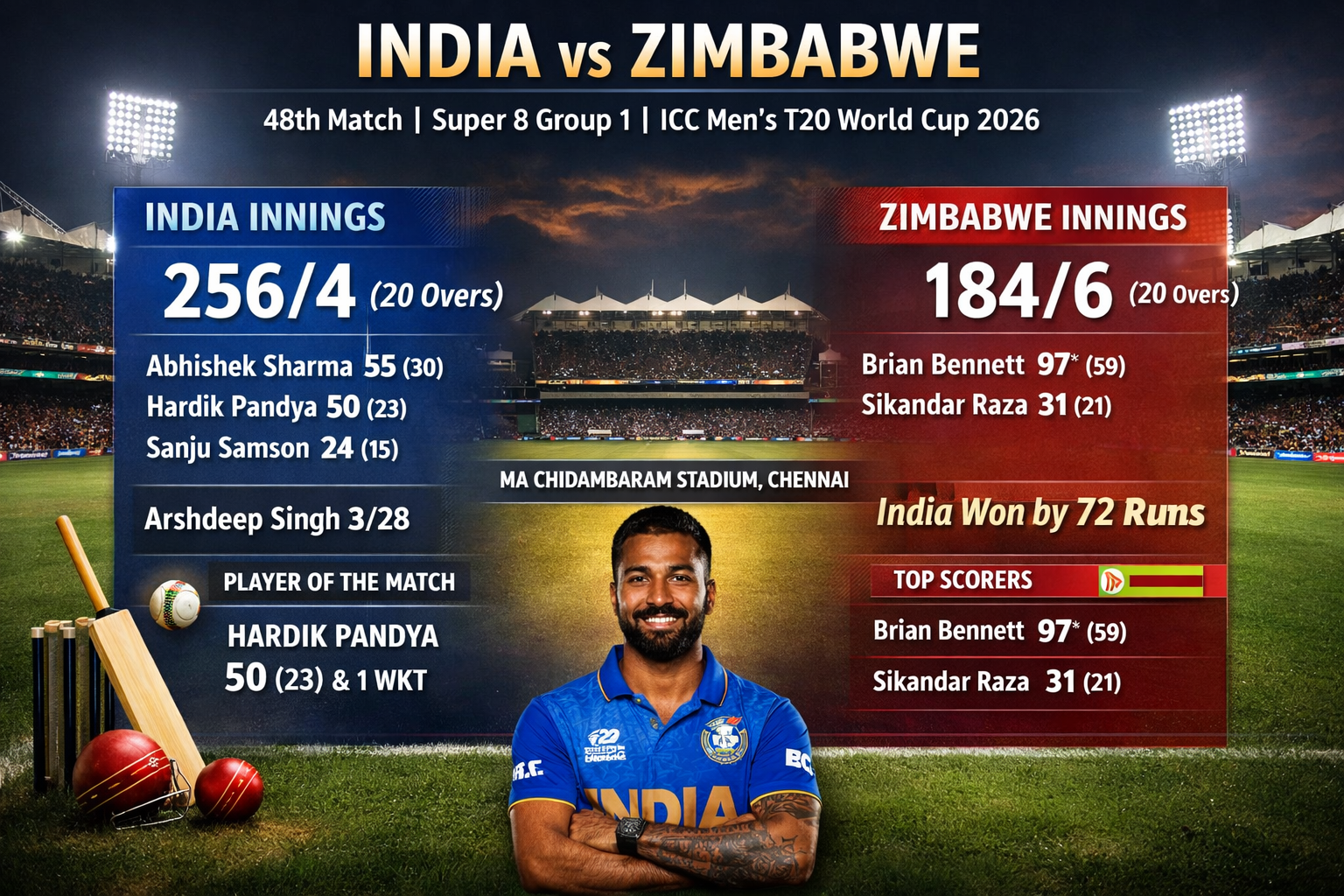
The India vs Zimbabwe, both innings scorecard 48th Match, Super 8 Group 1 (X1 v X2), ICC Men’s T20 World Cup 2026 turned into one of the most explosive batting displays of the tournament. Played in Chennai on 26 February 2026, the match combined fearless power-hitting, calculated risk-taking, and a determined chase that never quite caught up with the scale of India’s total.
In a tournament phase where net run rate and momentum often matter as much as wins, this game carried genuine knockout intensity. India national cricket team delivered a commanding performance, defeating Zimbabwe national cricket team by 72 runs after posting one of the highest totals in T20 World Cup history.
What followed was less about survival and more about statement cricket.
Match Overview — India vs Zimbabwe, Super 8 Group 1
Match: 48th Match, Super 8 Group 1 (X1 v X2)
Tournament: ICC Men’s T20 World Cup 2026
Venue: MA Chidambaram Stadium, Chennai
Result: India won by 72 runs
Player of the Match: Hardik Pandya
Final Scores:
- India — 256/4 (20 overs)
- Zimbabwe — 184/6 (20 overs)
- Target: 257
India’s 256/4 became the highest total of the 2026 edition and among the biggest ever recorded in T20 World Cup history.
India Innings — Controlled Aggression From Start to Finish
T20 cricket often rewards early momentum, but this innings stood out because of how consistently India accelerated across all phases. There was no single explosive over that defined the total; instead, pressure accumulated ball by ball.
Powerplay Foundation
Sanju Samson provided early intent with a brisk cameo, ensuring Zimbabwe’s seamers never settled into defensive lengths. Even after his dismissal, India avoided the typical slowdown that sometimes follows early wickets.
The turning point came through Abhishek Sharma, whose approach blended modern T20 aggression with intelligent strike rotation. His fifty wasn’t reckless hitting — it was structured acceleration.
Middle Overs: Momentum Without Risk
Unlike many T20 innings where teams consolidate after the powerplay, India maintained scoring above ten runs per over. Boundary options were chosen carefully, targeting matchups rather than swinging blindly.
Zimbabwe tried pace variations and spin through Sikandar Raza, but India’s batters consistently disrupted bowling plans by using depth of the crease and strong off-side hitting.
Death Overs Explosion
The late surge came from Hardik Pandya, whose half-century transformed an already strong total into a daunting one. His finishing phase highlighted why experienced all-rounders remain invaluable in tournament cricket — they understand when bowlers run out of options.
India struck 17 sixes and crossed 250 without appearing frantic, a sign of calculated dominance rather than chaos.
India Batting Scorecard
| Batter | Runs | Balls | 4s | 6s |
|---|---|---|---|---|
| Sanju Samson | 24 | 15 | 1 | 2 |
| Abhishek Sharma | 55 | 30 | 4 | 3 |
| (Middle-order contributions) | — | — | — | — |
| Hardik Pandya | 50 | 23 | — | — |
| Others (not out) | — | — | — | — |
Total: 256/4 in 20 overs
(Key contributions confirmed from official match scorecard)
Zimbabwe Bowling — Moments of Resistance, Limited Control
Zimbabwe’s bowlers were not entirely ineffective; they simply faced relentless pressure. On slower Chennai surfaces, variations usually bring rewards, but India’s batters anticipated pace changes well.
Blessing Muzarabani produced early breakthroughs, while Sikandar Raza kept things respectable during the middle phase. However, once the final five overs began, execution slipped slightly — and against a set batting lineup, small errors quickly become expensive.
This is often the hidden challenge for emerging teams in high-scoring games: maintaining precision when scoreboard pressure escalates.
Zimbabwe Chase — Brave Effort Led by Brian Bennett
Chasing 257 in T20 cricket demands an extraordinary start. Zimbabwe instead opted for measured aggression, likely hoping wickets in hand would allow a late surge.
That plan partially worked — but India’s total left almost no margin for quiet overs.
Bennett’s Outstanding Knock
The standout performance came from Brian Bennett, who scored an unbeaten 97 from 59 balls. His innings showed composure and technical clarity, especially against pace bowling.
Rather than swinging wildly, Bennett targeted gaps and built partnerships. For long stretches, he ensured Zimbabwe remained competitive on the scoreboard even if the required rate kept climbing.
Middle-Order Support
Sikandar Raza added a valuable contribution, briefly reviving hopes of an unlikely chase. Yet the difference between chasing 180 and chasing 256 became increasingly clear as required runs exceeded 15 per over.
India’s bowlers stayed disciplined, forcing Zimbabwe to hit against the field rather than through it.
Zimbabwe Batting Scorecard
| Batter | Runs | Balls | 4s | 6s |
|---|---|---|---|---|
| Brian Bennett* | 97* | 59 | 8 | 6 |
| Sikandar Raza | 31 | 21 | — | — |
| Others | — | — | — | — |
Total: 184/6 in 20 overs
Zimbabwe finished well short despite Bennett’s heroics.
India Bowling — Discipline Over Drama
In massive chases, bowlers often chase wickets instead of control. India avoided that trap.
Arshdeep Singh delivered the decisive spell, finishing with three wickets while maintaining economy under pressure. His ability to hit yorker lengths late in the innings prevented Zimbabwe from building finishing momentum.
The bowling plan appeared simple but effective:
- Protect straight boundaries
- Force cross-bat shots
- Use pace-off deliveries at key moments
Such clarity often separates successful tournament sides from inconsistent ones.
Tactical Turning Points
1. Boundary Percentage Difference
India generated a huge portion of runs through boundaries, reducing risk between deliveries. Zimbabwe, by contrast, relied more on running between wickets.
2. Death Overs Gap
India dominated the final five overs with explosive hitting, while Zimbabwe’s finishing phase remained controlled but insufficient.
3. Pressure of the Target
Chasing above 240 in T20 cricket changes batting psychology. Even good overs feel inadequate when required rate keeps rising.
What This Result Meant in the Super 8 Stage
This win kept India firmly alive in the semifinal race and significantly improved their net run rate — a critical factor in tightly contested Super 8 groups.
For Zimbabwe, the match showed progress rather than failure. Competing against a top side while producing an individual innings like Bennett’s reflects a team growing in confidence at global tournaments.
Match Context — Why High Totals Are Increasing
Modern T20 cricket increasingly rewards adaptable batting orders. Teams now structure innings around phases rather than traditional roles:
- Powerplay aggression
- Middle-overs strike rotation
- Specialist finishers
India’s approach in this match reflected that evolution perfectly. Every batter contributed to maintaining tempo rather than resetting the innings.
Key Performers at a Glance
Best Batter (India): Abhishek Sharma — 55 (30)
Best Finisher: Hardik Pandya — 50 (23)
Best Batter (Zimbabwe): Brian Bennett — 97* (59)
Best Bowler: Arshdeep Singh — 3 wickets
Frequently Asked Questions (FAQ)
Who won the India vs Zimbabwe 48th match in the T20 World Cup 2026?
India won the match by 72 runs after scoring 256/4 and restricting Zimbabwe to 184/6 in 20 overs.
What was the highest individual score in the match?
Brian Bennett scored 97 not out for Zimbabwe, the highest individual score of the game.
Who was named Player of the Match?
Hardik Pandya received the award for his explosive half-century and overall impact.
Why was India’s total considered special?
It became the highest score of the 2026 tournament and one of the biggest totals in T20 World Cup history.
Did Zimbabwe compete well despite losing?
Yes. Bennett’s innings and steady middle-order resistance showed strong competitiveness even against a massive target.
Cricket matches sometimes hinge on moments; others reflect complete performances. This encounter belonged firmly in the second category. India combined planning, execution, and confidence across all departments, while Zimbabwe produced individual brilliance that hinted at a promising future — even in defeat.
