
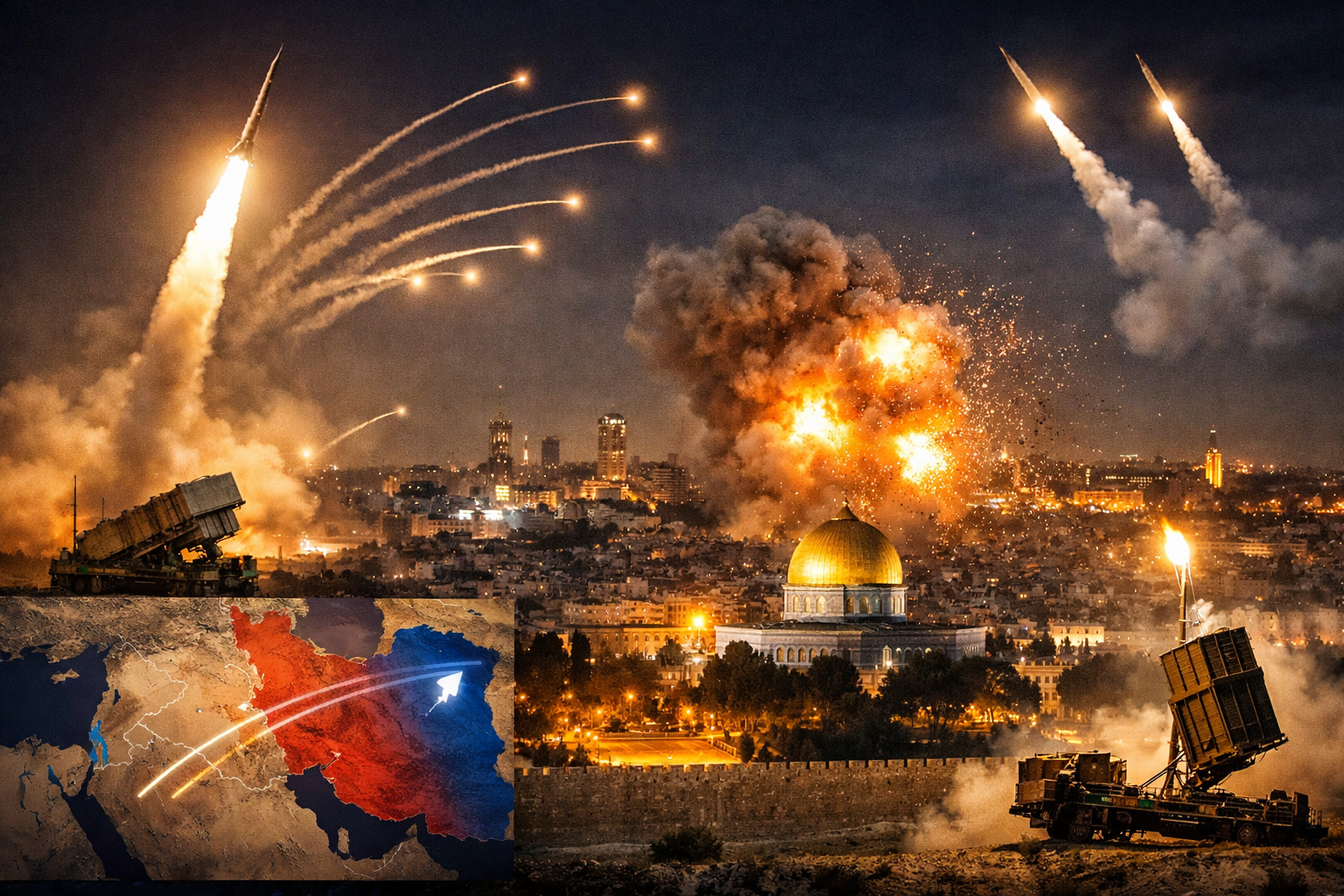
Reports claiming that Iranian ballistic missiles bypassed air defence systems and struck Jerusalem spread rapidly across news sites and social platforms. The wording sounds definitive, but the reality is more layered. In conflicts involving long-range missiles and layered defences, the gap between what is launched, what is intercepted, and what ultimately lands can be wide.
This piece looks at the claim with a steady lens. It separates confirmed information from disputed reports, explains how air defence systems work in practice, and outlines why even advanced defences can sometimes fail — or appear to fail — under specific conditions.
The claim in context
The central claim is straightforward: Iranian ballistic missiles bypassed air defence systems and struck Jerusalem. Variations of this statement have appeared with different levels of certainty, some citing unnamed sources, others relying on images or short video clips that are difficult to independently verify.
Jerusalem is one of the most sensitive locations in the region, politically and symbolically. Any suggestion that a long-range missile reached the city immediately raises the stakes and amplifies scrutiny. That alone is reason enough to slow down and examine the details.
What matters here is not only whether something landed, but what landed, where it landed, and how those conclusions were reached.
How Israel’s air defence is designed to work
Israel operates a layered air defence network built to address different threats at different ranges and altitudes. These layers are not a single shield but a series of systems designed to overlap.
At the lower end, systems focus on short-range rockets and drones. At higher altitudes, other systems are designed to intercept ballistic missiles during various phases of flight. The idea is redundancy: if one layer fails or is saturated, another has a chance to engage.
Even so, no air defence system is airtight. Defence planners themselves acknowledge this. Interception rates are high, but never 100 percent, especially when facing coordinated launches, decoys, or advanced trajectories.
Why “bypassed” does not always mean “defeated”
The phrase “bypassed air defence” sounds dramatic, but in technical terms it can mean several different things.
A missile might not be engaged if it is assessed to be heading toward an unpopulated area. It might break apart in flight, dropping debris that later causes damage. It might be intercepted, but fragments still reach the ground. Or the missile may follow a flight profile that shortens the interception window.
In some cases, what appears to be a strike is actually interceptor debris or remnants from a mid-air engagement. In urban areas, distinguishing between a direct hit and falling fragments is not always immediately possible, especially in the first hours after an incident.
What has been officially confirmed
As of now, official statements have been cautious. Israeli authorities, including the Israel Defense Forces, have typically confirmed missile launches and interceptions without publicly detailing every impact location.
This restraint is not unusual. Military briefings often prioritise operational security and public calm over granular disclosure. When details are released, they tend to follow after assessments are complete.
On the Iranian side, officials have historically framed missile launches as demonstrations of capability rather than detailed battle damage reports. That leaves a gap in verified, mutually acknowledged facts.
The role of ballistic missiles in Iran’s strategy
Iran has invested heavily in ballistic missile development over several decades. These systems are central to its deterrence posture, particularly given limitations in its air force.
Ballistic missiles offer range, speed, and psychological impact. Even when intercepted, they force adversaries to expend costly interceptors and keep populations under constant alert. From a strategic perspective, penetration is only one measure of success; disruption and signalling matter too.
That context is essential when assessing claims that Iranian ballistic missiles bypassed air defence systems and struck Jerusalem. The messaging impact alone can serve strategic goals, regardless of physical damage.
Jerusalem as a target: why reports spread so fast
Jerusalem is not just another city. It carries religious, political, and emotional weight far beyond its geographic size. Any report involving Jerusalem spreads faster and is examined less skeptically in the early stages.
Images labelled as “Jerusalem” circulate widely, even when geolocation is uncertain. Nighttime footage, in particular, is easy to misattribute. Without clear landmarks, confirming location requires careful analysis that rarely happens on social media timelines.
This does not mean every report is false. It means the threshold for verification needs to be higher than usual.
Air defence saturation and modern missile tactics
One reason air defence systems struggle is saturation. When multiple missiles or drones are launched simultaneously, defenders must make rapid decisions about what to intercept and what to ignore.
Modern missile tactics may also include manoeuvring re-entry vehicles, decoys, or mixed salvos that combine different types of threats. These are designed to complicate tracking and overwhelm response systems.
In such scenarios, even a well-integrated defence can allow some objects through. Whether those objects are intact warheads, fragments, or decoys is a separate question.
Civilian impact versus military assessment
From a civilian perspective, any explosion or debris falling in a city feels like a failure of defence. From a military perspective, outcomes are measured differently: casualties prevented, infrastructure protected, and threats neutralised.
This difference in perspective often fuels confusion. A defence system can be considered operationally successful while still allowing visible impacts. That nuance is rarely reflected in early headlines.
When discussing whether Iranian ballistic missiles bypassed air defence systems and struck Jerusalem, it is important to ask whose definition of “success” or “failure” is being applied.
Information gaps and why they persist
Conflicts involving advanced weapons generate information gaps by design. Militaries restrict data, journalists face access limits, and analysts rely on open-source material that takes time to verify.
Satellite imagery, radar data, and interceptor telemetry are not immediately public. By the time they are analysed, public attention may have already moved on.
This lag does not invalidate initial reports, but it does mean early certainty is often misplaced.
Regional implications if the claim proves accurate
If it were conclusively shown that Iranian ballistic missiles directly struck Jerusalem after bypassing all defence layers, the implications would be serious.
It would suggest either a technical leap in missile capability or a vulnerability in defence coverage. Both would prompt reassessment by regional actors and allies.
However, strategic shifts are not made on single incidents alone. Patterns matter more than isolated outcomes, especially in systems-on-systems competition.
Why careful language matters
Words like “bypassed,” “penetrated,” and “struck” carry specific meanings in military analysis. Using them loosely can distort public understanding.
Responsible reporting distinguishes between confirmed impacts, probable debris, and unverified claims. That distinction is not about downplaying events; it is about accuracy.
In this case, saying that Iranian ballistic missiles bypassed air defence systems and struck Jerusalem may turn out to be accurate in some form. It may also turn out to be an oversimplification.
What to watch for next
Clearer information usually emerges in stages. Official assessments, satellite analysis, and independent investigations help narrow uncertainty.
Pay attention to consistency across sources, not volume. Repetition does not equal confirmation. Details such as crater analysis, damage patterns, and interceptor engagement timelines are more telling than dramatic footage.
Until those details are available, caution is not avoidance — it is the most honest position.
Frequently asked questions
Did Iranian ballistic missiles actually hit Jerusalem?
At this stage, claims exist but public confirmation is limited. Some reports may refer to debris or interceptor fragments rather than intact warheads.
Can Israel’s air defence systems be completely bypassed?
No air defence system is perfect. Under saturation or complex attack profiles, some objects may get through or partially through.
Why wouldn’t all missiles be intercepted?
Defence systems prioritise threats based on trajectory and risk. Objects heading toward open areas may not be engaged.
Does interception always mean no damage on the ground?
Not necessarily. Intercepted missiles can still produce falling debris that causes explosions or structural damage.
Why is information released so slowly?
Military assessments take time, and sensitive data is often withheld for operational and security reasons.
Does this change the regional balance of power?
Single incidents rarely do. Long-term trends in capability and doctrine matter more than isolated outcomes.
Events involving missiles, air defence, and major cities demand careful reading. The difference between what is claimed and what is confirmed is where real understanding begins.
