
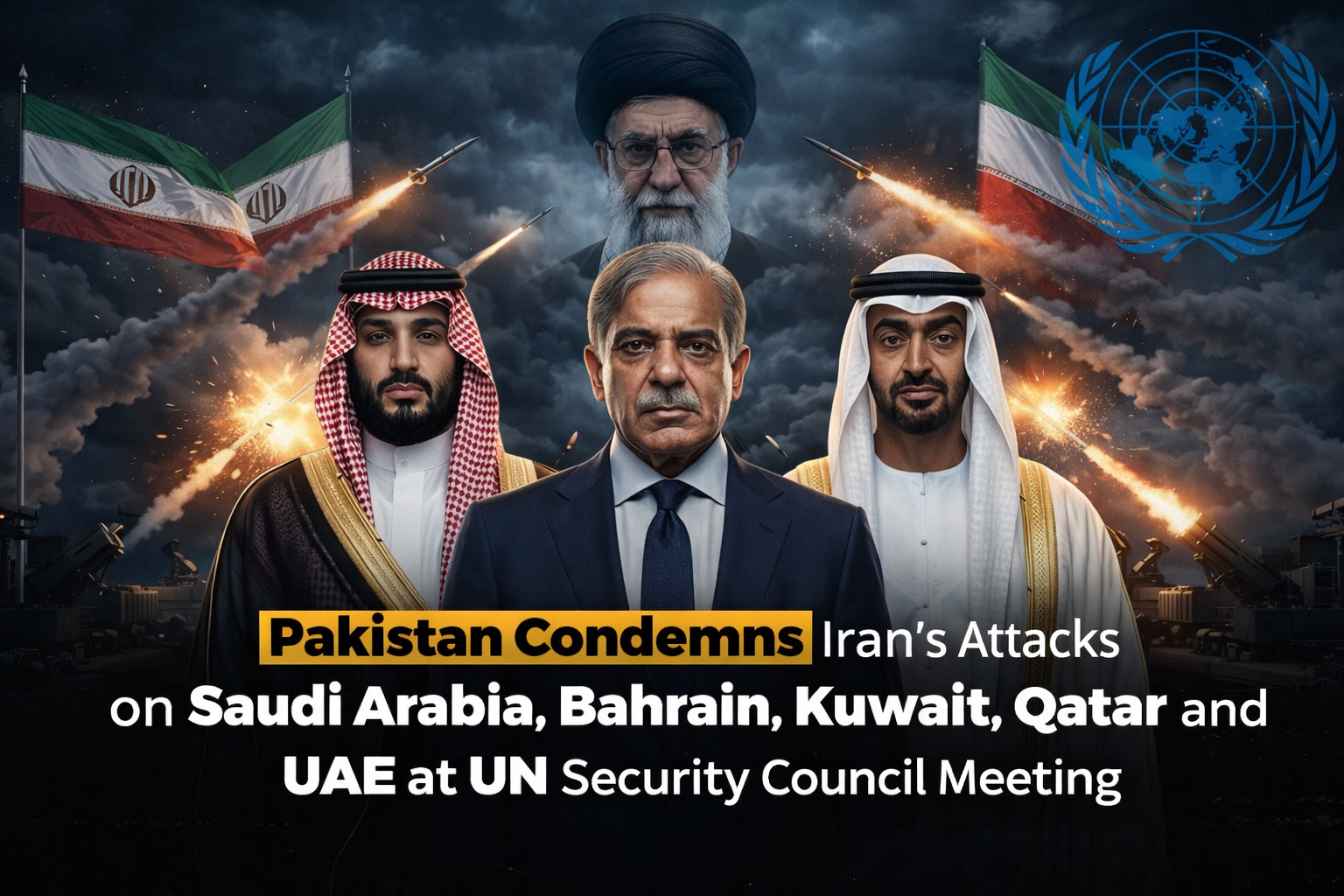
Pakistan condemns Iran’s attacks on Saudi Arabia, Bahrain, Kuwait, Qatar and UAE at UN Security Council Meeting — a statement that quickly drew international attention and reshaped diplomatic conversations across the Gulf region.
The development came at a sensitive time for regional security. Tensions between Tehran and several Gulf states have long simmered beneath the surface, but open condemnation at the United Nations marks a significant diplomatic moment.
For Pakistan, the issue is not merely rhetorical. It touches on regional stability, economic interests, diaspora ties, and its broader foreign policy balance between neighboring Iran and long-standing Gulf partners.
This article unpacks what happened at the UN Security Council, why Pakistan took this stance, and what it could mean for the wider Middle East.
What Happened at the UN Security Council?
The issue surfaced during a meeting of the United Nations Security Council, the global body responsible for maintaining international peace and security.
Representatives discussed rising tensions in the Gulf following reported Iranian attacks targeting critical infrastructure and strategic locations in:
- Saudi Arabia
- Bahrain
- Kuwait
- Qatar
- United Arab Emirates
Pakistan’s permanent representative addressed the council, expressing concern over violations of sovereignty and calling for restraint. The tone was firm but measured — condemning the attacks while urging dialogue over escalation.
This balance is characteristic of Islamabad’s diplomatic language in complex regional disputes.
Pakistan’s Official Position
Pakistan’s statement centered on three key principles:
1. Respect for Sovereignty
Islamabad emphasized that attacks on sovereign states undermine international law and regional stability. This framing aligns with Pakistan’s longstanding support for territorial integrity in global affairs.
2. Regional Stability as a Shared Interest
Pakistan underlined that instability in the Gulf affects not just the immediate region but global energy markets and security dynamics.
Millions of Pakistanis live and work in Gulf countries. Remittances from these states play a substantial role in Pakistan’s economy. Disruptions in the Gulf can have ripple effects far beyond the battlefield.
3. Call for Dialogue
While condemning the attacks, Pakistan avoided inflammatory language. It encouraged diplomatic engagement and de-escalation rather than confrontation.
This is consistent with Pakistan’s efforts in recent years to position itself as a stabilizing voice rather than a partisan actor.
Why This Statement Matters
Public condemnations at the UN are not routine gestures. They carry diplomatic weight.
Pakistan shares a long border with Iran and maintains diplomatic relations with Tehran. At the same time, its economic and strategic ties with Gulf Cooperation Council states are deep and multifaceted.
Taking a clear position in such a context requires careful calculation.
Economic Realities
Saudi Arabia and the UAE are among Pakistan’s key economic partners. They have provided financial assistance during difficult economic periods and host large Pakistani expatriate communities.
Instability affecting oil facilities or maritime routes in the Gulf could disrupt global energy prices. For an energy-importing country like Pakistan, that has direct domestic consequences.
Security Considerations
Pakistan’s western border security dynamics often intersect with regional geopolitics involving Iran. Islamabad has, at times, mediated or attempted to reduce tensions between Tehran and Riyadh.
Condemning attacks does not necessarily signal hostility toward Iran. It may instead reflect a broader commitment to non-aggression norms.
The Gulf States’ Perspective
For the Gulf countries involved, attacks attributed to Iran represent more than isolated incidents. They are seen as part of a broader pattern of proxy tensions, maritime threats, and drone or missile strikes targeting infrastructure.
Saudi Arabia, in particular, has previously faced attacks on energy facilities that rattled global markets. Smaller states like Bahrain and Kuwait are equally sensitive to sovereignty violations due to their geographic size and strategic location.
Pakistan’s condemnation may be interpreted as diplomatic solidarity — a signal that regional powers expect disputes to be resolved within international legal frameworks.
Balancing Between Iran and the Gulf
One of the more nuanced aspects of Pakistan’s foreign policy is its balancing act.
On one side is Iran — a neighbor with whom Pakistan shares religious, cultural, and economic ties. On the other side are Gulf monarchies that serve as major trade partners and employment destinations for millions of Pakistanis.
Publicly condemning Iran at the UN Security Council is not a minor gesture. It suggests that Islamabad views regional escalation as a greater risk than potential diplomatic friction.
At the same time, Pakistan avoided endorsing punitive measures or military retaliation. That restraint reflects an understanding that escalation benefits no one in an already volatile region.
Broader Regional Implications
The Middle East has experienced waves of confrontation over the past decade, from proxy conflicts to maritime tensions in strategic waterways.
If attacks on Gulf states intensify, several consequences could unfold:
- Increased military presence by global powers
- Strained energy supply chains
- Heightened sectarian narratives
- Pressure on neutral states to take sides
Pakistan’s statement can be read as an attempt to prevent such a chain reaction.
Diplomatic condemnation, when paired with calls for restraint, often serves as an early-warning mechanism in international politics — signaling that a situation is serious but still manageable.
The Role of the UN Security Council
The UN Security Council often becomes a stage for diplomatic signaling rather than immediate solutions. Resolutions require consensus among permanent members, which is rarely easy in geopolitically sensitive cases.
However, even statements without binding resolutions can influence narratives.
When countries like Pakistan speak out, they contribute to shaping international expectations. Silence, in diplomacy, can sometimes be interpreted as tacit approval. Speaking up clarifies alignment with international norms.
Energy Security and Global Markets
Attacks in the Gulf are never purely regional matters.
The Gulf region supplies a significant share of the world’s oil exports. Any disruption — whether temporary or prolonged — can lead to market volatility.
For countries already facing inflationary pressures, energy instability adds another layer of economic strain.
Pakistan’s condemnation may partly reflect awareness that energy shocks abroad quickly translate into domestic challenges at home.
Diplomatic Signaling Without Escalation
An important nuance in Pakistan’s statement is tone.
There was no sweeping accusation or aggressive rhetoric. Instead, the language focused on principles: sovereignty, restraint, stability.
This kind of wording allows room for future diplomacy. It avoids burning bridges while still marking a clear position.
In international relations, that balance often matters more than volume.
What Comes Next?
The immediate question is whether tensions will escalate or cool down.
Much depends on back-channel diplomacy between Tehran and Gulf capitals. Regional actors such as Oman and others have historically played mediating roles in similar disputes.
Pakistan itself has, in past years, offered to facilitate dialogue between rival regional powers.
If escalation continues, the Security Council may revisit the matter. If diplomacy prevails, this episode may be remembered as a tense but contained moment.
Either way, Pakistan’s condemnation will likely be cited in future diplomatic exchanges as evidence of where it stood during this episode.
Pakistan’s Strategic Calculus
Foreign policy decisions rarely exist in isolation.
Pakistan must weigh:
- Border management with Iran
- Economic reliance on Gulf remittances
- Domestic political sentiment
- Its broader positioning within the Islamic world
Condemning attacks while avoiding direct hostility reflects a pragmatic approach.
It signals adherence to international norms without foreclosing future diplomatic engagement.
That approach is not unique to Pakistan. Many mid-sized powers adopt similar strategies when navigating disputes among larger or strategically significant neighbors.
FAQ: Pakistan Condemns Iran’s Attacks on Saudi Arabia, Bahrain, Kuwait, Qatar and UAE at UN Security Council Meeting
Why did Pakistan condemn Iran’s attacks at the UN?
Pakistan cited concerns about sovereignty and regional stability. Given its economic and diplomatic ties with Gulf states, instability in the region directly affects its national interests.
Does this mean Pakistan’s relations with Iran will worsen?
Not necessarily. Diplomatic condemnation does not automatically translate into a breakdown in relations. Pakistan’s language emphasized restraint, suggesting it seeks stability rather than confrontation.
How do Gulf tensions affect Pakistan’s economy?
Many Pakistanis work in Gulf countries and send remittances home. Additionally, disruptions in oil supply can raise global energy prices, impacting Pakistan’s import costs.
What role can the UN Security Council actually play?
The council can issue statements, pass resolutions, or encourage mediation. While it cannot always enforce immediate solutions, its discussions shape global diplomatic narratives.
Could Pakistan act as a mediator?
Pakistan has previously offered to facilitate dialogue between regional rivals. Whether it plays that role here depends on willingness from both sides and broader geopolitical conditions.
Regional crises rarely have simple storylines. The statement that Pakistan condemns Iran’s attacks on Saudi Arabia, Bahrain, Kuwait, Qatar and UAE at UN Security Council Meeting reflects deeper strategic calculations rather than a single event reaction.
In a region where alliances are fluid and tensions can escalate quickly, careful words matter. Pakistan’s stance suggests it is prioritizing stability, economic security, and adherence to international norms — while keeping doors open for dialogue in a complex and evolving geopolitical landscape.

One thought on “Pakistan Condemns Iran’s Attacks on Saudi Arabia, Bahrain, Kuwait, Qatar and UAE at UN Security Council Meeting”