
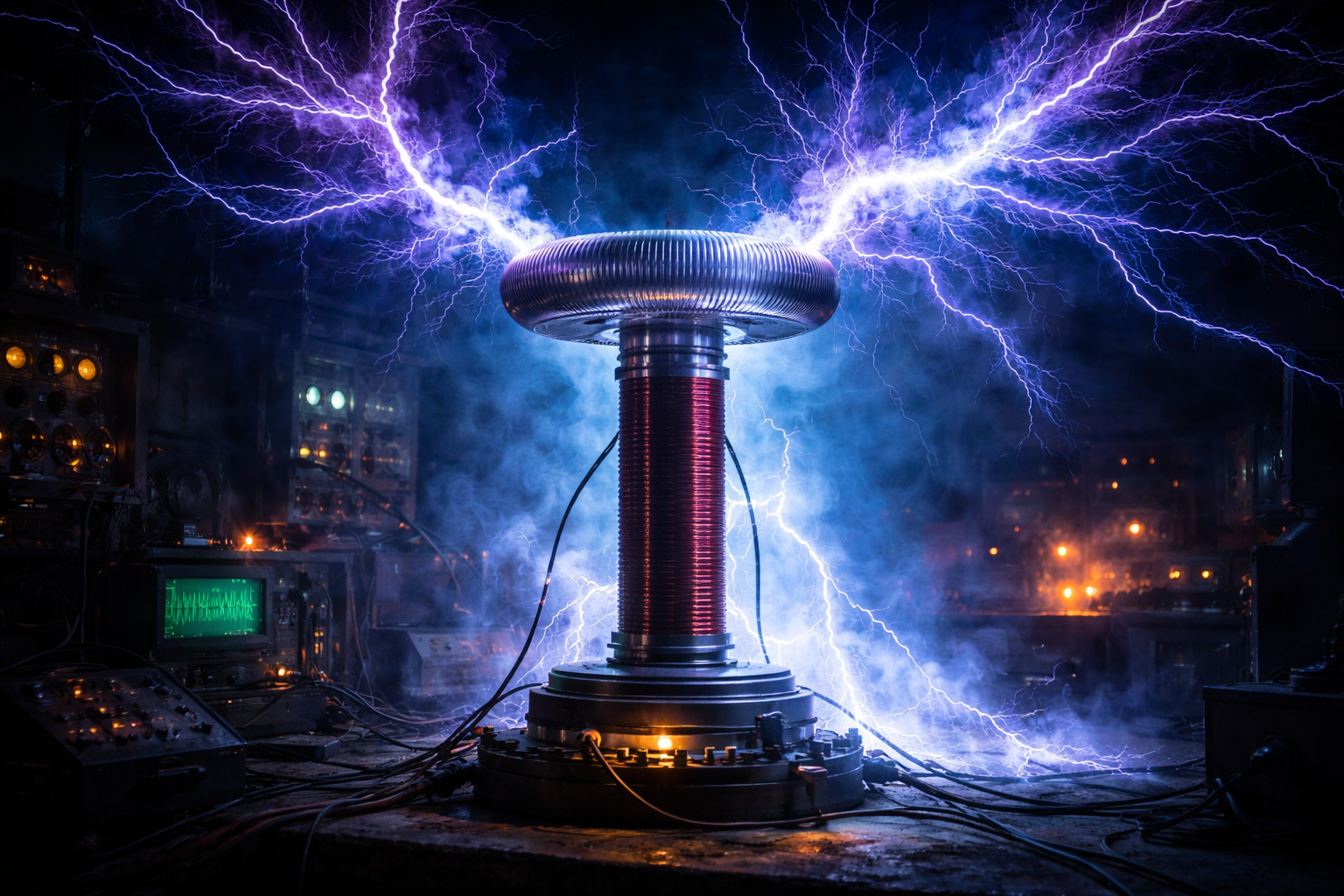
The Experiment That Still Feels Like Science Fiction
When people first encounter a Tesla coil in action, the reaction is usually the same: surprise, curiosity, and a little disbelief. Lightning seems to leap through the air, sparks crackle loudly, and nearby fluorescent lights suddenly glow without being plugged in. It looks less like a classroom experiment and more like a special effect pulled from a futuristic video game.
The Tesla coil guide starts with understanding that this iconic device was never meant to be a spectacle. It was originally developed by the Serbian-American inventor Nikola Tesla in the late 19th century as part of his ambitious research into wireless electricity and high-frequency power transmission. What began as an experimental transformer eventually became one of the most recognizable demonstrations in the entire field of electrical engineering.
Today, Tesla coils remain a staple in science museums, physics laboratories, and hobbyist workshops. Despite being more than a century old, the technology still offers valuable lessons about resonance, electrical fields, and the foundations of wireless energy systems.
Why the Tesla Coil Still Matters
In the broader context of electrical history, the Tesla coil represents a turning point in how scientists explored electricity. During Tesla’s time, electricity was already being used for lighting and industry, but many of its deeper properties were still poorly understood.
Tesla was particularly interested in high-frequency alternating current. While much of the world was focused on practical electrical infrastructure during the era known as the War of the Currents, Tesla was experimenting with ideas that felt almost futuristic. His research aimed to transmit electricity through the air, potentially eliminating wires entirely.
The Tesla coil became the tool that made those experiments possible. By producing extremely high voltages at very high frequencies, it allowed scientists to study electrical behavior that ordinary transformers simply could not generate.
Even though Tesla’s dream of large-scale wireless electricity never materialized in the way he envisioned, the principles behind the Tesla coil still influence modern technologies. Radio transmission, wireless charging, and resonant inductive coupling all trace some conceptual roots back to experiments like these.
How a Tesla Coil Actually Works
At first glance, a Tesla coil might look complicated, but the underlying idea is surprisingly elegant. The device is essentially a specialized type of transformer designed to produce extremely high voltages.
A typical Tesla coil system contains several key parts working together.
The process begins with a power supply that feeds energy into a primary circuit. This circuit includes a capacitor and a coil of wire known as the primary coil. When the capacitor releases its stored energy, the current flows through the coil, creating a rapidly oscillating magnetic field.
Nearby sits the secondary coil, usually a tall, tightly wound cylinder of wire. Because of electromagnetic induction, the oscillating magnetic field from the primary coil transfers energy into this secondary coil. The two coils are tuned to resonate at the same frequency, which dramatically amplifies the voltage.
This resonance effect is the real star of the show. It allows relatively modest input power to produce extremely high voltages at the output. When the voltage becomes strong enough, it ionizes the surrounding air, creating the visible electrical arcs that make Tesla coils famous.
At the top of the secondary coil, a metal sphere or toroid distributes the electric field evenly and helps control the shape and behavior of the sparks. Without it, the coil would discharge unpredictably.
What looks chaotic is actually a carefully balanced system of resonance, capacitance, and electromagnetic coupling.
The Visual Spectacle of High-Frequency Electricity
One reason the Tesla coil guide remains popular is simply the visual drama. Few scientific devices produce such striking effects.
When operating, Tesla coils generate purple-white electrical arcs that can stretch several feet into the air. The arcs often crackle loudly, creating a sound that feels halfway between lightning and static electricity.
Another unusual effect is wireless illumination. If you hold a fluorescent tube near an active Tesla coil, the tube will glow even though it isn’t connected to a power source. The strong electromagnetic field excites the gas inside the bulb, causing it to emit light.
In modern demonstrations, Tesla coils are sometimes synchronized with music, creating performances where electrical arcs pulse in rhythm with sound. These setups are often called “musical Tesla coils,” and they transform a scientific device into something resembling an electrical instrument.
While these displays are entertaining, they also highlight the fundamental concept behind the technology: energy moving through electromagnetic fields rather than wires.
From Laboratory Tool to Cultural Icon
Over time, the Tesla coil has evolved from a niche research tool into a symbol of experimental science itself.
It frequently appears in science fiction, movies, and video games as shorthand for advanced or dangerous technology. Giant coils shooting lightning are practically a visual trope at this point. The imagery taps into the public’s fascination with electricity as both powerful and mysterious.
This cultural visibility also helped revive interest in the work of Nikola Tesla. For decades after his death, Tesla was a relatively obscure figure outside engineering circles. Today he is widely recognized as one of the most imaginative inventors of the electrical age.
Modern hobbyists and engineers have kept the Tesla coil tradition alive by building increasingly sophisticated versions. Some are designed purely for demonstrations, while others explore experimental physics concepts such as plasma generation and wireless power transfer.
Despite advances in electronics, the basic design remains surprisingly faithful to Tesla’s original experiments from the 1890s.
Safety and Practical Considerations
For anyone interested in experimenting with a Tesla coil, safety is a critical part of the discussion.
The voltages produced by Tesla coils can reach hundreds of thousands of volts. While the high-frequency current behaves differently from standard household electricity, it can still cause burns, electrical shocks, and interference with electronic devices.
Modern builders often use solid-state Tesla coils that rely on advanced electronics rather than traditional spark gaps. These designs allow more precise control and are generally safer to operate in controlled environments.
Proper insulation, grounding, and safe operating distances are essential. Tesla coils can also disrupt nearby electronics, including computers and communication equipment, because of the strong electromagnetic fields they generate.
In other words, the device that looks like a science fair attraction is still very much a powerful electrical machine.
Where Tesla Coil Technology Is Headed
Although Tesla coils are mostly used for demonstrations today, the underlying concepts remain relevant in modern research.
Wireless charging systems for smartphones and electric vehicles rely on resonant inductive coupling, a principle closely related to the resonance used in Tesla coils. Engineers continue exploring ways to improve efficiency and transmission distance.
There is also renewed interest in wireless energy transfer for specialized applications, including powering remote sensors or equipment in difficult environments.
While it’s unlikely that entire cities will ever receive electricity through the air the way Tesla once imagined, the fundamental idea of transmitting energy without direct wiring continues to evolve.
In that sense, the Tesla coil isn’t just a historical curiosity. It’s part of an ongoing story about how engineers experiment with the boundaries of electricity.
Conclusion
The Tesla coil guide ultimately reveals more than just how to build or operate an unusual electrical device. It highlights a moment in scientific history when inventors were pushing the limits of what electricity could do. Created by Nikola Tesla during an era of intense technological change, the Tesla coil became both a research tool and a symbol of electrical experimentation. Its dramatic arcs of lightning captured public imagination while advancing scientific understanding of resonance and high-frequency currents.More than a century later, the device still fascinates engineers, hobbyists, and science enthusiasts alike. It demonstrates fundamental principles of electromagnetism in a way that textbooks alone cannot match.Even in a world filled with advanced electronics and wireless technology, the Tesla coil remains a reminder of how curiosity-driven experiments can shape the future of science.
