
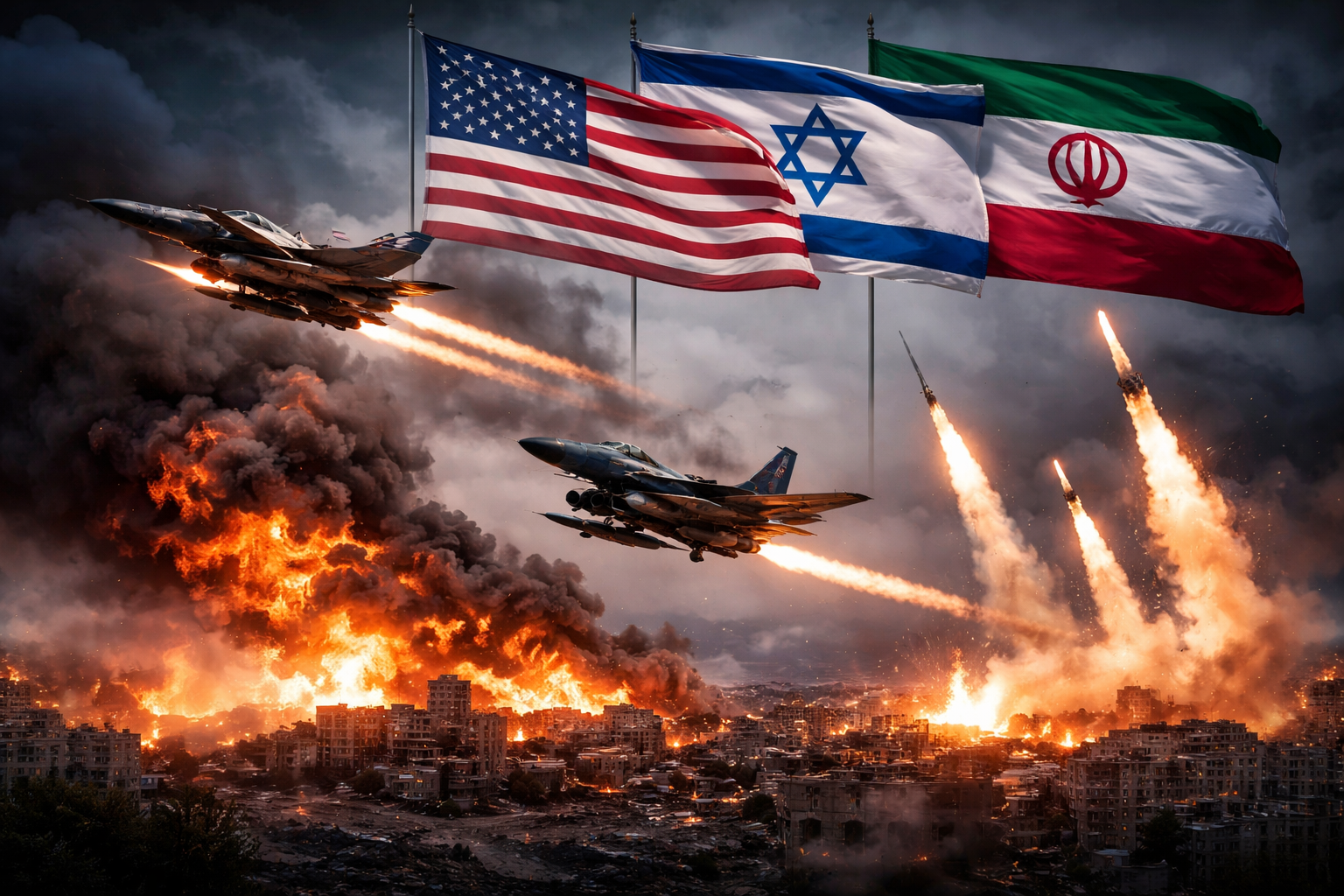
The world reacts to US, Israel attack on Iran, Tehran retaliation with a mix of urgency, caution, and strategic recalibration. What began as a targeted military operation quickly evolved into a geopolitical flashpoint, drawing responses from regional powers, global heavyweights, energy markets, and ordinary citizens watching events unfold in real time.
Within hours of the initial strikes, air defenses were activated across parts of the Middle East. Governments issued travel advisories. Oil markets surged. Diplomats opened emergency channels. The exchange did not occur in isolation—it landed in a region already strained by proxy conflicts, nuclear negotiations, and shifting alliances.
This is not simply another episode in a long-standing rivalry. It is a moment that forces governments to reassess risk, deterrence, and the boundaries of military action.
The Trigger: A Coordinated Strike
According to official statements, the United States and Israel carried out coordinated strikes on Iranian-linked military infrastructure. Targets reportedly included weapons storage facilities, missile production sites, and command centers associated with regional operations.
Washington framed the action as necessary to protect personnel and allies. Israeli officials described it as preemptive defense against emerging threats. Both governments emphasized that the strikes were limited in scope and aimed at specific military objectives.
Tehran, however, condemned the operation as an act of aggression and a violation of sovereignty.
As is often the case in high-stakes military exchanges, competing narratives emerged immediately. Each side presented its version of intent and impact. Independent verification remains complex, particularly in fast-moving situations where information is tightly controlled.
Tehran Retaliation: Measured or Escalatory?
Iran’s response came swiftly. Missiles and drones were launched toward military-associated targets linked to both countries. Air defense systems were activated across the region, intercepting several projectiles.
Iranian officials described their action as proportionate and defensive. State media highlighted resilience and deterrence. The message was clear: Iran would not absorb strikes without response.
The scale of retaliation is central to understanding what happens next. If Tehran intended to signal capability without crossing certain red lines, it may aim to keep the exchange contained. But military signaling is inherently risky. What one side sees as controlled, another may interpret as escalation.
In volatile environments, perception can matter more than intent.
Regional Reactions: Caution and Calculation
Gulf States Walk a Fine Line
Countries in the Gulf responded carefully. Public statements from governments such as Saudi Arabia and United Arab Emirates urged restraint and dialogue.
These states have complex relationships with both Washington and Tehran. They rely on US security partnerships but also seek economic stability and reduced regional tension.
A prolonged conflict would threaten shipping routes, investor confidence, and energy exports. Their interest lies in de-escalation—not in being drawn into another open-ended confrontation.
Iraq and Lebanon: The Proxy Concern
In Iraq and Lebanon, where Iranian-aligned groups operate, the concern is immediate.
Local leaders fear that their territories could become indirect battlegrounds. Even if direct exchanges remain limited, affiliated militias might initiate actions that widen the conflict.
Recent history has shown how quickly regional theaters can expand when proxy networks are activated. Governments in these countries are under pressure to prevent spillover while managing internal political divisions.
Israel: Defensive Readiness and Political Stakes
Within Israel, air defense systems were placed on high alert. Officials emphasized deterrence and preparedness, reassuring the public while signaling resolve externally.
Security decisions are rarely detached from domestic politics. Leadership credibility often hinges on the perception of strength and protection. At the same time, prolonged instability carries its own political cost.
The United States: Deterrence Without Entrapment
The United States now faces a familiar challenge: demonstrate strength while avoiding deeper entanglement.
Washington’s messaging has focused on deterrence—making clear that attacks on US personnel or allies will prompt response. Yet officials have also signaled that they do not seek broader war.
This balancing act is not new. For decades, US strategy in the Middle East has revolved around preventing adversaries from expanding influence while limiting direct, large-scale military commitments.
The stakes include troop safety across regional bases, alliance credibility, and global energy stability.
Europe: Diplomatic Urgency
Leaders across the European Union responded with calls for de-escalation.
European governments remain invested in diplomatic frameworks surrounding Iran’s nuclear activities. Escalation complicates inspection regimes, negotiation channels, and long-term non-proliferation goals.
There is also economic sensitivity. Energy price spikes affect households and industries across the continent. Inflationary pressure and supply chain vulnerabilities make stability more urgent than ever.
Europe’s leverage may be limited, but its diplomatic engagement remains active.
Russia and China: Strategic Positioning
Russia and China criticized the strikes and urged restraint.
Both nations have expanded ties with Tehran in recent years, particularly in energy and defense cooperation. Their responses reflect broader geopolitical competition with Washington.
However, neither Moscow nor Beijing appears eager for full-scale regional war. Disruption of trade corridors and energy supplies would have economic consequences for them as well.
Their posture suggests criticism without direct involvement—at least for now.
Energy Markets: The Strait Factor
Whenever Iran is directly involved in military escalation, attention turns to the Strait of Hormuz.
A significant portion of the world’s oil shipments pass through this narrow waterway. Even the perception of risk can drive up prices.
Insurance rates for shipping vessels often spike during periods of tension. Airlines reroute flights to avoid contested airspace. Commodity traders adjust positions rapidly.
The economic ripple effect extends far beyond the Middle East. From Asia to Europe to North America, energy-dependent industries monitor developments closely.
The Nuclear Dimension
At the heart of much of this tension lies Iran’s nuclear program.
Western governments, particularly the United States and Israel, have long argued that Iran’s enrichment activities could shorten the pathway to weaponization. Tehran maintains its program is for civilian energy and research purposes.
Negotiations over inspection frameworks and enrichment limits have fluctuated over the years. Military escalation makes diplomatic progress more difficult.
Hardline factions within Iran may argue that deterrence requires acceleration. Conversely, international actors may push harder for renewed oversight.
The outcome is uncertain. Much depends on whether political leadership on all sides sees value in returning to negotiation.
Information Warfare and Public Opinion
Modern conflicts unfold not only on battlefields but across screens.
Social media platforms have amplified both verified information and misleading narratives. Video clips circulate before independent confirmation is possible. Claims of damage or casualties are often revised.
Public opinion influences policy. In democratic societies, sustained military engagement without clear goals can erode support. In more centralized systems, state media shapes perception more directly.
The information environment can either fuel escalation or create pressure for restraint.
Risk of Miscalculation
History shows that escalation often occurs not through deliberate choice but through miscalculation.
A missile that misses its intended target. An interception failure. An unintended civilian casualty. These incidents can alter political narratives overnight.
Military planners understand this risk. So do diplomats.
The existence of back-channel communication—often facilitated by neutral intermediaries—can reduce misunderstanding. While such channels are rarely publicized, they are common in high-risk moments.
Their effectiveness may determine whether this episode remains contained.
Humanitarian Implications
Even limited strikes carry humanitarian consequences.
Civilians in affected areas face air raid warnings, temporary displacement, and infrastructure disruption. Medical facilities may operate under strain. Supply chains can be interrupted.
If escalation continues, displacement could rise. Aid organizations monitor developments carefully, though access often depends on security conditions.
The human cost, while less visible in strategic debates, remains central to long-term stability.
Economic and Political Calculations
Every government involved must now calculate next steps carefully.
For the United States and Israel, maintaining deterrence credibility is crucial. For Iran, demonstrating resilience without inviting overwhelming retaliation is equally important.
Regional actors must decide how visibly to align. Global powers will balance criticism with strategic interests.
No party appears to benefit from full-scale war. Yet history suggests that crises can evolve in unexpected ways.
The Global Diplomatic Push
Diplomatic engagement is often most intense when headlines suggest the opposite.
Emergency meetings, direct calls between foreign ministers, and quiet mediation efforts frequently occur behind closed doors.
Neutral states sometimes serve as intermediaries, passing messages that prevent misunderstandings.
The presence of these mechanisms offers some reassurance. But diplomacy requires political will. Whether leaders prioritize restraint over escalation will shape the coming weeks.
Broader Geopolitical Context
This confrontation unfolds against a backdrop of shifting global alignments.
The Middle East has seen recalibration in recent years—rapprochement between historic rivals, expanded economic partnerships, and new security arrangements.
A sustained US–Israel–Iran confrontation could disrupt that trajectory.
For global powers, the situation intersects with broader strategic competition. Energy routes, arms sales, regional influence—all are part of a larger chessboard.
Events in one theater often ripple into others.
Military Capabilities and Strategic Messaging
Military exchanges are rarely only about immediate impact. They are also about signaling capability and resolve.
Missile defense systems, drone interception technologies, cyber capabilities—all send messages.
Demonstrating interception success can bolster public confidence. Displaying precision strike capacity can reinforce deterrence.
Yet signaling carries risk. Overconfidence can lead to escalation. Underestimation can invite further challenge.
Strategic messaging must align with political goals.
What Happens Next?
Several scenarios are possible.
The exchange could taper off, with both sides declaring objectives met and shifting back to indirect competition.
Alternatively, proxy groups could initiate actions that expand the theater. Cyber operations could intensify. Maritime incidents could occur.
A worst-case scenario would involve sustained direct strikes, drawing in additional actors.
Much depends on restraint, communication, and political calculation.
The Role of International Institutions
Global institutions, including the United Nations, often call for immediate ceasefire and negotiation in moments like this.
While enforcement power may be limited, diplomatic platforms provide space for dialogue.
Resolutions, emergency sessions, and monitoring efforts can influence narratives and create off-ramps.
Institutional diplomacy may not resolve deep-seated rivalry, but it can reduce immediate risk.
Public Sentiment Across Regions
In some cities, protests have emerged condemning military action. In others, rallies have expressed solidarity with national leadership.
Diaspora communities often feel the impact acutely, balancing emotional ties with security concerns.
Economic anxiety is widespread. Energy prices affect daily life, from transportation to household costs.
Governments must manage both strategic threats and public mood.
Long-Term Implications
Even if immediate escalation subsides, trust has been further strained.
Military exchanges harden perceptions. Diplomatic compromise becomes politically more difficult.
The nuclear question remains unresolved. Proxy dynamics persist. Regional rivalries continue.
This episode may not redefine the region overnight, but it reinforces underlying fault lines.
FAQ: World Reacts to US, Israel Attack on Iran, Tehran Retaliation
Why did this escalation happen now?
Timing often reflects accumulated tension rather than a single trigger. Security assessments, intelligence findings, and regional developments likely influenced the decision.
Are other Middle Eastern countries getting involved?
So far, most governments are urging restraint rather than direct participation. However, proxy actors could influence developments.
How serious is the risk to global oil supply?
Short-term disruptions are possible if tensions affect shipping routes. Markets often react strongly even to perceived threats.
Is diplomacy still possible?
Yes. Even during active exchanges, back-channel communication and third-party mediation often continue quietly.
Could this impact nuclear negotiations?
Military escalation makes diplomacy harder but not impossible. Political leadership decisions will determine whether talks resume or stall further.
The world reacts to US, Israel attack on Iran, Tehran retaliation with a blend of urgency and caution. Markets fluctuate. Diplomats engage. Military forces remain alert.
Whether this moment becomes a contained episode or a turning point depends less on initial strikes and more on what leaders choose next. In geopolitics, escalation is rarely automatic—but neither is restraint.

One thought on “World Reacts to US, Israel Attack on Iran, Tehran Retaliation”